
You can deliver a well-prepared lecture with clear slides and a strong pace, and still lose half the room by minute 20. The content isn’t the problem.
Three studies looked at what actually changes when you redesign a lecture around real-time student responses. A 2026 peer-reviewed study at The Hong Kong Polytechnic University with 800 students. A peer-reviewed study at PAREF Springdale in the Philippines. And a school-wide implementation at Safa British School in Dubai.
Different countries, different age groups, different subjects, and the same three things kept breaking down in all of them.
This post covers what those breakdowns were, and three student engagement strategies that fix them. Each takes under five minutes and works on its own.
Why Long Lectures Lose Students (And Why It’s Not Their Fault)
The lecture format has a built-in problem: it asks students to receive information for extended periods without doing anything with it. That’s not a student motivation issue. It’s a structural one.
Across three ClassPoint-supported studies conducted in 2026, HK PolyU in Hong Kong, PAREF Springdale in the Philippines, and Safa British School in Dubai, researchers found the same three failure modes appearing regardless of subject, age group, or country.
The same voices always dominated
In every context, participation clustered around the most confident students. At HK PolyU, a handful of students dominated class discussion while the rest stayed silent.
At PAREF Springdale, quiet students held back rather than risk being wrong in front of the class. At Safa British School, primary pupils with strong ideas rarely found a way into the conversation. The format favored confidence, not understanding.
Teachers couldn’t see the room in real time
In all three studies, instructors had no reliable way to know whether students were following along until work was submitted and graded. By then, misconceptions had hardened and the lesson had moved on.
At PAREF Springdale, this showed up in test scores: the lecture-only class averaged 24.2 out of 40 on the posttest, with only five of 25 students passing.
The feedback loop was too slow to be useful.
Active-looking class, but passive minds
Students showed up, they took notes and completed tasks, but the HK PolyU researchers described this as compliance rather than genuine thinking. Students were performing participation, not doing the intellectual work the lesson was designed for.
All three studies found the same gap between looking engaged and actually being engaged.
Each of these student engagement strategies below fixes one of these directly.
Strategy 1 – Surface: Find Out What the Room Is Already Thinking
What it Fixes: the same voices dominating.
Before you introduce new content, ask the room a question, not for a grade, not to cold-call anyone, but to see what students are already carrying into the lesson.
An anonymous prompt, whether a word cloud, a quick poll, or a prior knowledge check, collects a response from every student at once. No hand-raising, no waiting to be picked. Everyone answers in the same moment.
This is where the participation shift happened in all three studies. At Safa British School, 97% of pupils reported feeling more engaged during lessons, and the reason students gave was consistent across the board:
“I can prove myself in lessons without having to be picked by raising my hand.”
— Safa British School student
At HK PolyU, researchers found that removing social risk changed who participated. Quieter students who had stayed silent in traditional discussions started contributing because the format finally let them.
The insight isn’t that these students didn’t know the material. It’s that the format had never asked them in a way that felt safe.
How to apply it:
- Word cloud: ask students to submit one word or phrase that comes to mind before you introduce the concept
- Opening poll: ask a true/false or multiple choice question to surface prior knowledge or common assumptions
- Prior knowledge check: short answer prompt asking what they already know about the topic
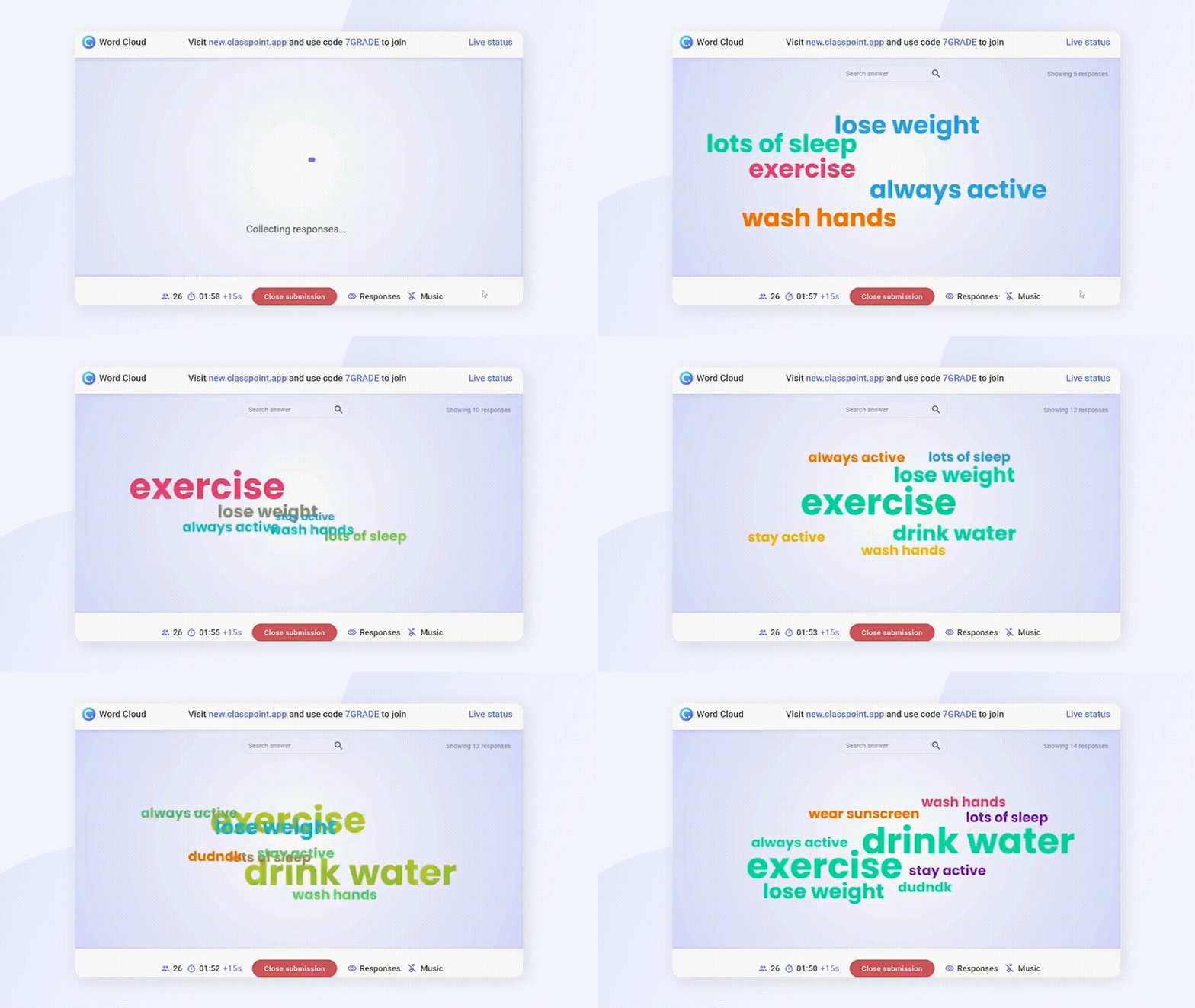
Example: Before starting a unit on climate systems, ask students to type one word they associate with the topic. Display the word cloud. Use what comes up to shape where you start.
Read the full writeup: The Safa British School case study details what teachers told students before the first session, one paragraph that removed most of the friction.
Strategy 2 – Practice: Give Every Student Something to Do Mid-Lecture
What it Fixes: no real-time view of understanding.
At a natural pause point mid-lecture, give every student a prompt to respond to individually before you move on. Not a discussion, not a show of hands, a response from every person in the room, submitted at the same time.
This is how misconceptions get caught while they can still be fixed. At PAREF Springdale, the teacher added live checkpoints to his existing slides and could see in real time where students were getting stuck. The class with those checkpoints ended the unit with a 78% pass rate.
The class without them ended at 60%, same teacher, same slides. The full study breakdown covers exactly how he structured those checkpoints.
“These help me stay engaged in the class rather than just sleeping.”
— PAREF Springdale student
How to apply it:
- Short answer: ask students to explain a concept in one sentence in their own words
- Fill in the blanks: give students a sentence with a key term removed and ask them to complete it
- Think-pair-share: pose a question, give students a moment to respond individually, then discuss with a neighbour
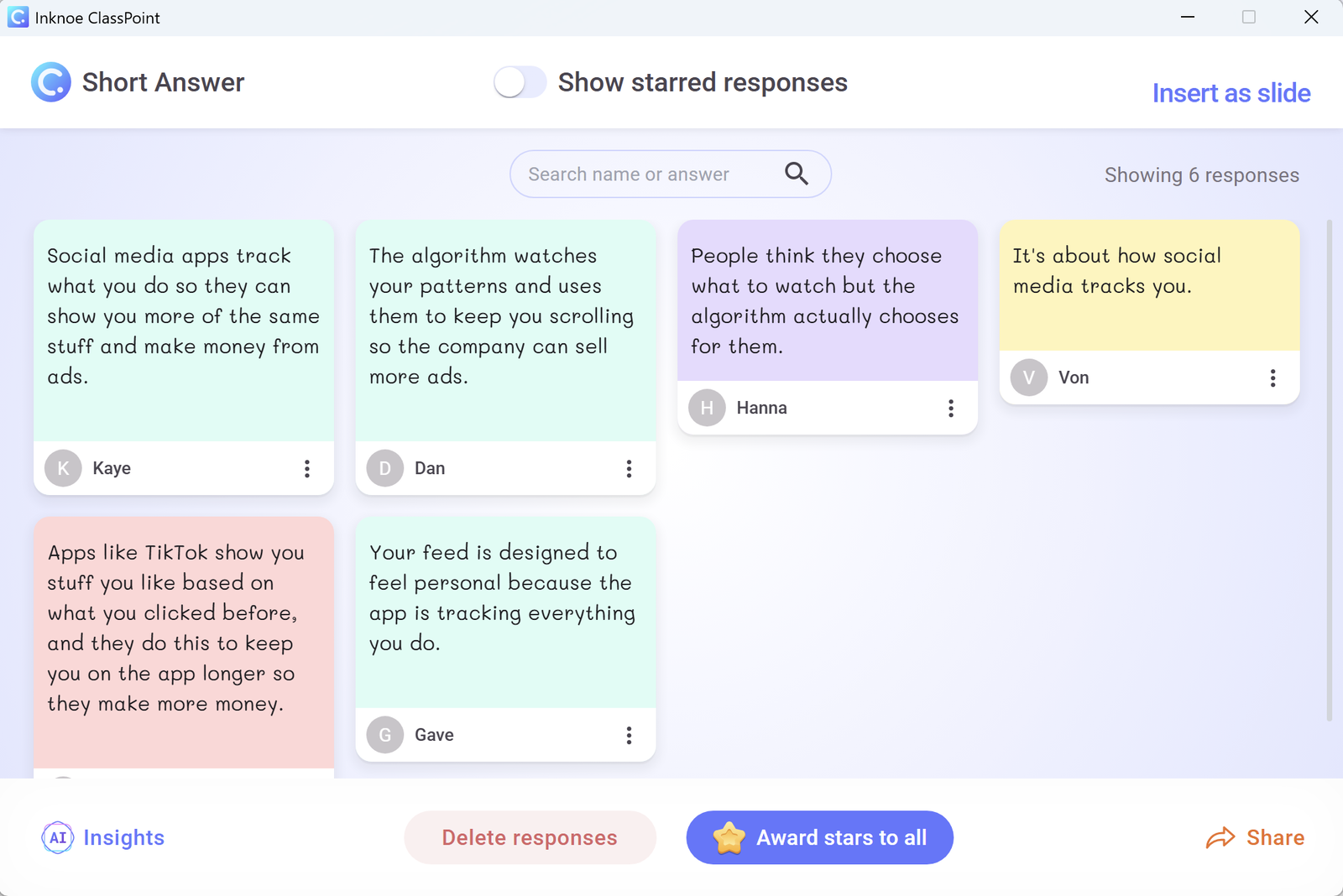
Example: Mid-way through a concept, ask: “In one sentence, explain what happens at this step and why.” Read a few responses before continuing.
Looking for more ideas? Here are 8 ways to check for understanding mid-lesson
Strategy 3 – Close the Loop
What it Fixes: participation that looks like engagement but isn’t.
After students respond, display a few of their answers on screen and discuss them. Use what they actually wrote, not a hypothetical example. This is what turns a response exercise into genuine thinking: students see their own ideas alongside others and have to evaluate what makes one answer work better than another.
At HK PolyU, this was where the feedback shifted. Because every student had submitted a response, the instructor could address the whole room’s thinking, not just the confident few. Quieter students were more willing to engage in the discussion because their thinking was already visible and anonymous on screen.
How to apply it:
- Display short answer responses and pick two or three to discuss as a class
- Ask students to vote on which response best captures the concept
- Show a weaker and a stronger example side by side and ask what makes the difference
Example: After a short answer prompt, show three anonymous responses. Ask the class: which one captures the idea most accurately, and what would make the others stronger?
The HK PolyU writeup covers how the instructor handled students who assumed their answers were being graded, worth reading before your first session.
How the Three Work Together: The 3-Phase Engagement Reset
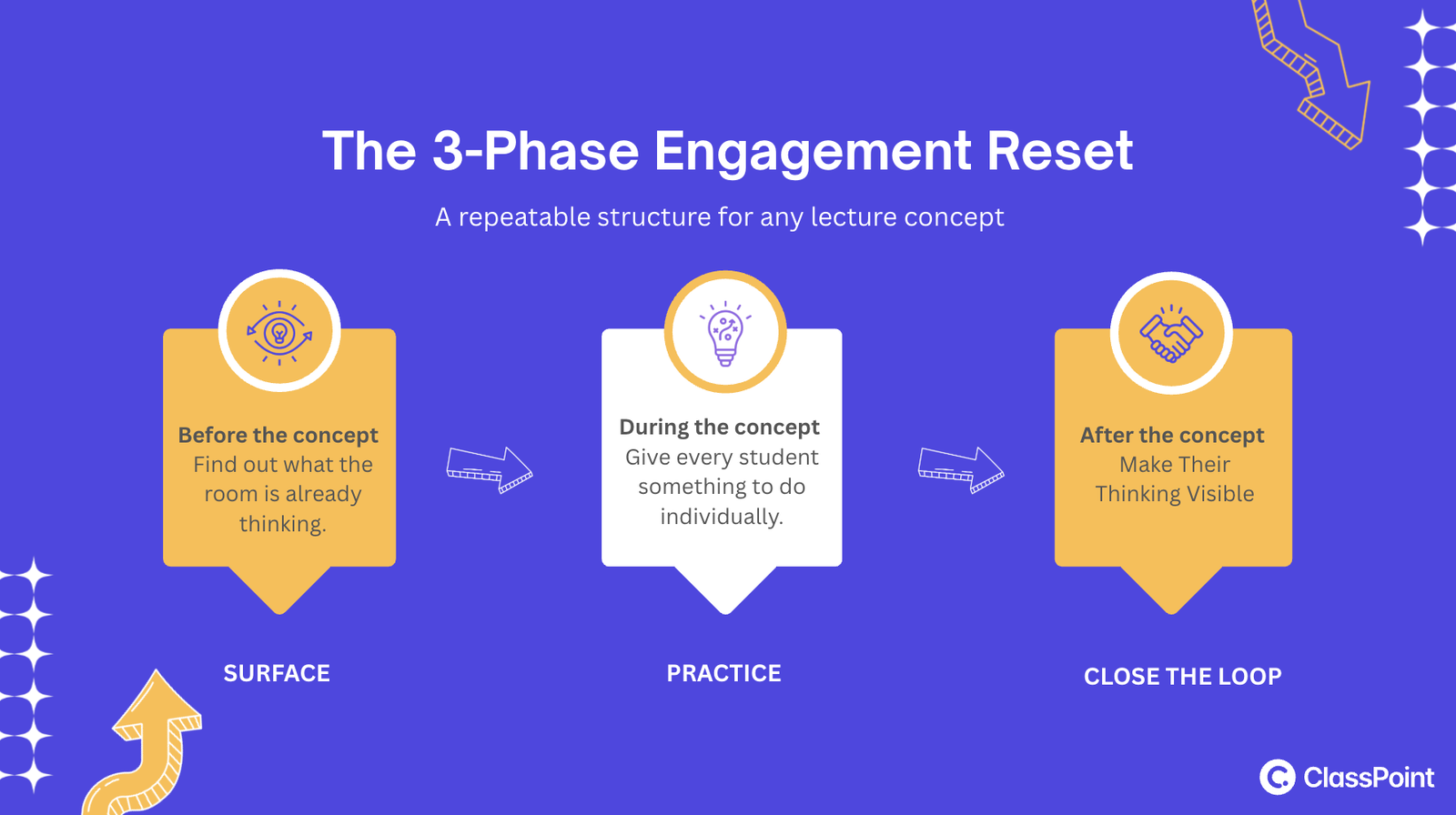
Each of these student engagement strategies works on its own. But when you run all three in sequence, they form a complete engagement cycle: Surface before the concept, Practice during it, Close the Loop after it.
It takes roughly 10 to 15 minutes across a lecture. Three intentional pause points, built into slides you already have.
One thing worth knowing before you try it: the HK PolyU researchers found that using live response tools did not reduce teacher workload. It redistributed it.
What that redistribution looks like in practice is this: less time coaxing participation, more time doing the work only a teacher can do. You decide which response is worth showing the class. You notice what a wrong answer reveals about where students actually are. You know how to turn a surprising answer into the most useful moment of the lesson. The strategies give you the material. What you do with it is still teaching.
“ClassPoint did not reduce professional workload so much as redistributing it.”
— Har & Sullivan, Applied Language Sciences (2026)
One Thing to Do Before Trying Any Student Engagement Strategies
In all three studies, some students resisted the new format at first. Not because the activities were difficult, but because they assumed anything they submitted was being graded or judged.
Before your first session, tell students three things: responses are anonymous, nothing they submit affects their grade, and the prompts are there to help them think, not to test them. One minute of context removes most of the friction, and it’s worth doing every time you introduce a new format.
