
When this research team first studied ClassPoint, they asked the teachers. This time, they asked the students.
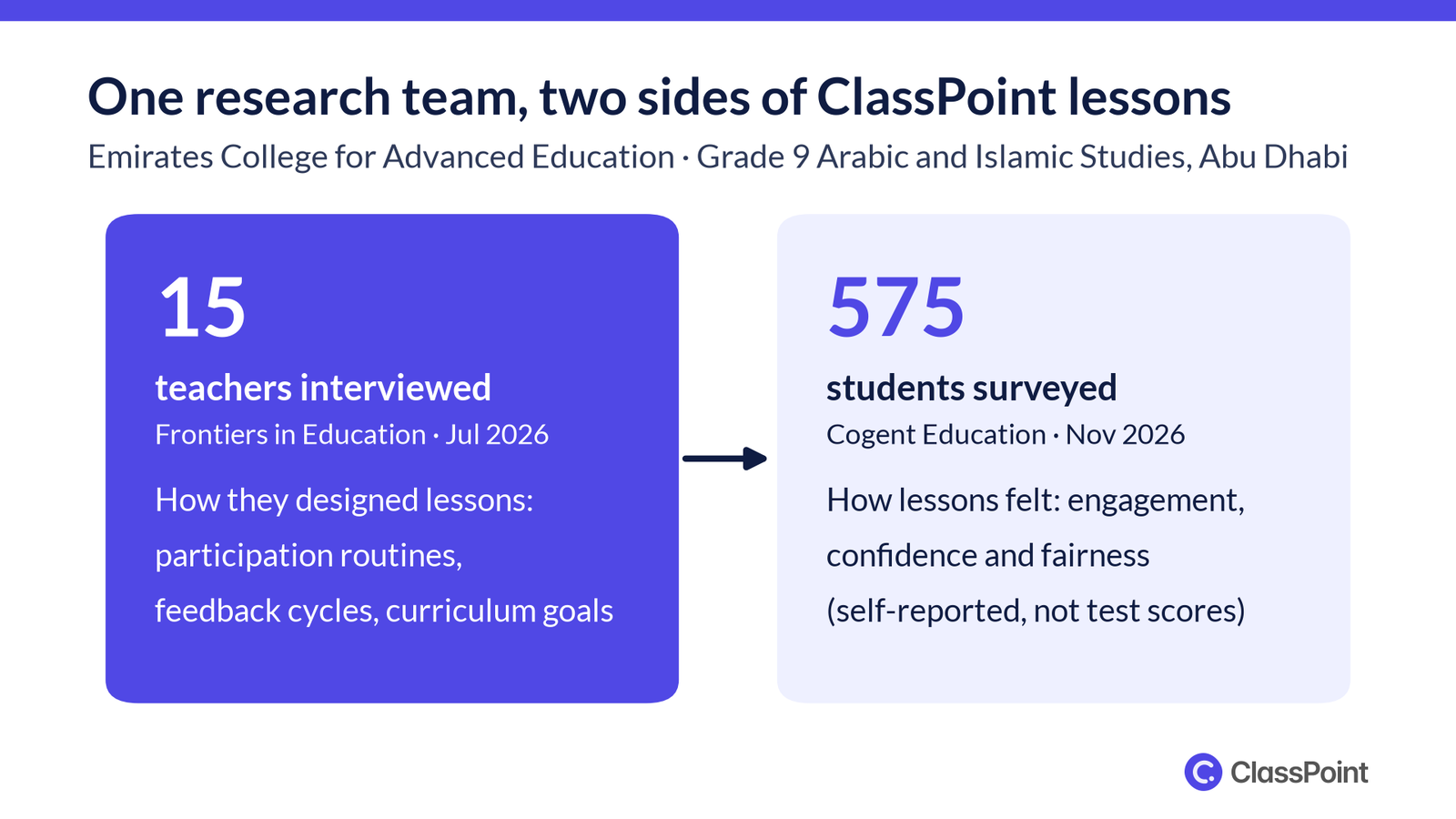
Researchers at the Emirates College for Advanced Education (ECAE) surveyed 575 Grade 9 students across 17 public schools in Abu Dhabi, after four months of Arabic and Islamic Studies lessons that ran on ClassPoint.
The question was simple: how did those lessons feel? Did students feel engaged, confident enough to answer, and given a fair chance to take part?
The short answer on ClassPoint student engagement: mostly yes, with one honest catch worth knowing about before your next lesson.
How Two Studies Connect: 15 Teachers First, Then 575 Students
This is the second paper from the same ECAE team. The first, published in Frontiers in Education, interviewed 15 Grade 9 Arabic and Islamic Studies teachers about how they designed their ClassPoint lessons over a four-month rollout. They described building participation routines, feedback loops and activities tied to curriculum goals. We covered it in our earlier Emirates College post.
The new paper, published in Cogent Education, turns to the other side of the room and asks the students how those lessons felt.
What 575 Students Reported
Students rated three areas on a five-point scale, anonymously, at the end of the term. The share who agreed or strongly agreed:
- Engagement and motivation: 83.0%
- Confidence and feeling safe to take part: 80.9%
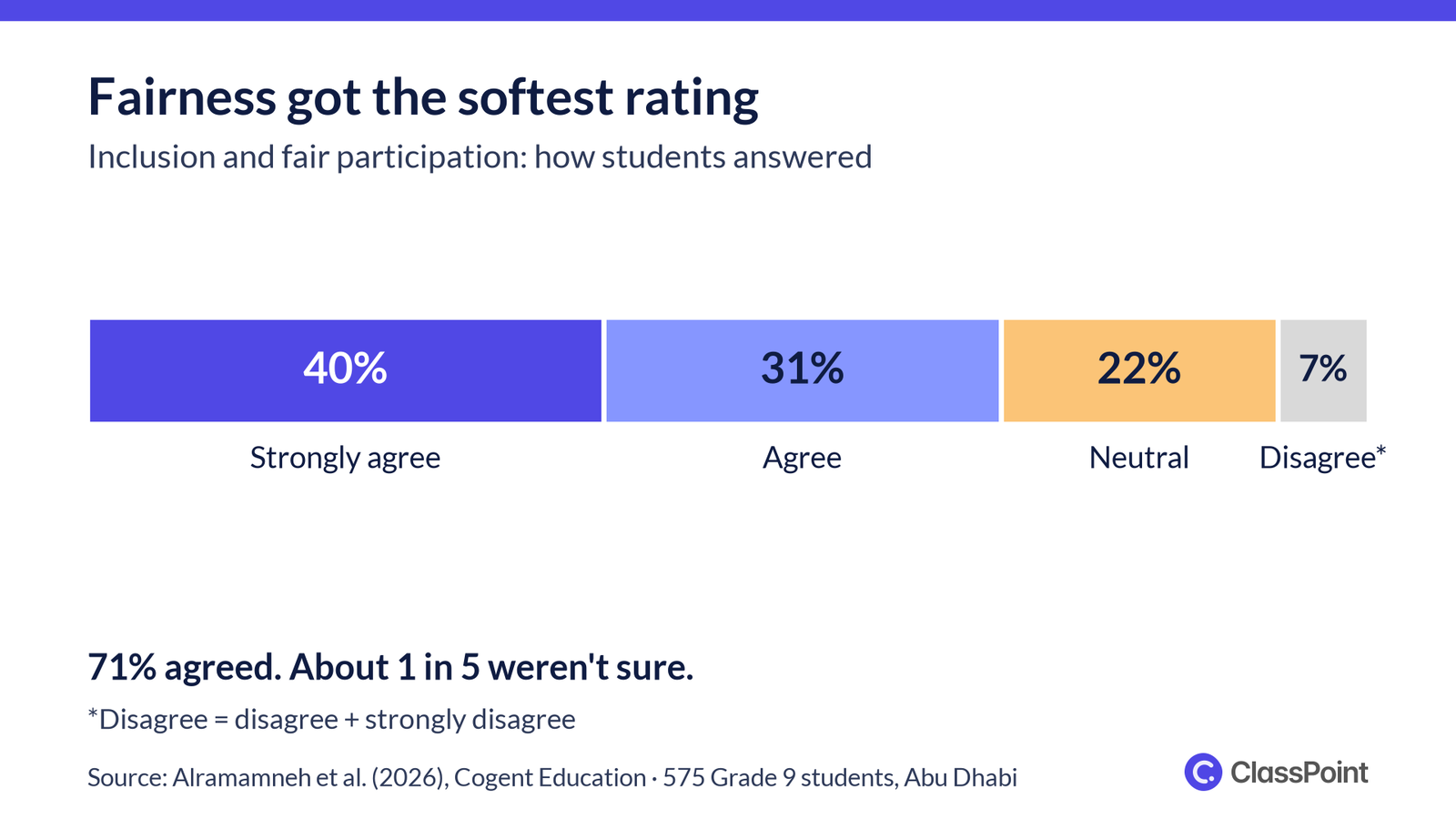
- Inclusion and fair participation: 71.3%
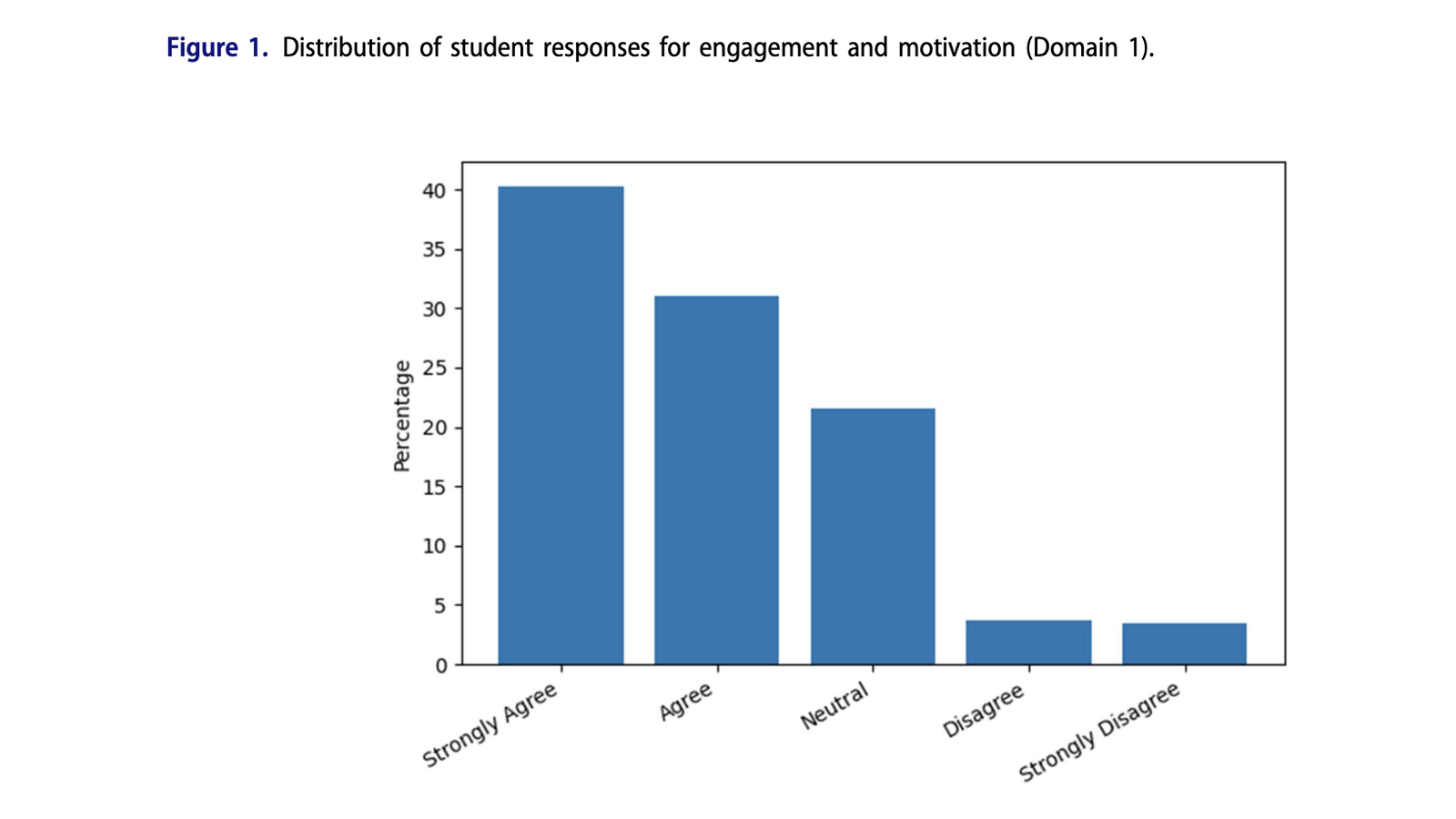
All three leaned clearly positive. But the third number stands apart, and the gap between the three areas was statistically significant (Friedman test, p < .001). On fairness, 21.6% of students picked “neutral”. That’s about one student in five who wasn’t sure everyone got an equal chance to take part.
Keep in mind these are students’ own ratings of how lessons felt, not test scores.
Related study: For learning results, look at PAREF Springdale in Cebu. In Grade 9 algebra, the class with ClassPoint questions built into the slides averaged about 78% on the posttest, against about 60% for a class taught from the same slides without them. Read the PAREF Springdale study
Students Felt Safe to Answer
The most striking number in the paper is .94. That’s how closely students’ engagement ratings tracked their confidence ratings. Students who said the lessons held their attention almost always also said they felt comfortable answering and sharing ideas.
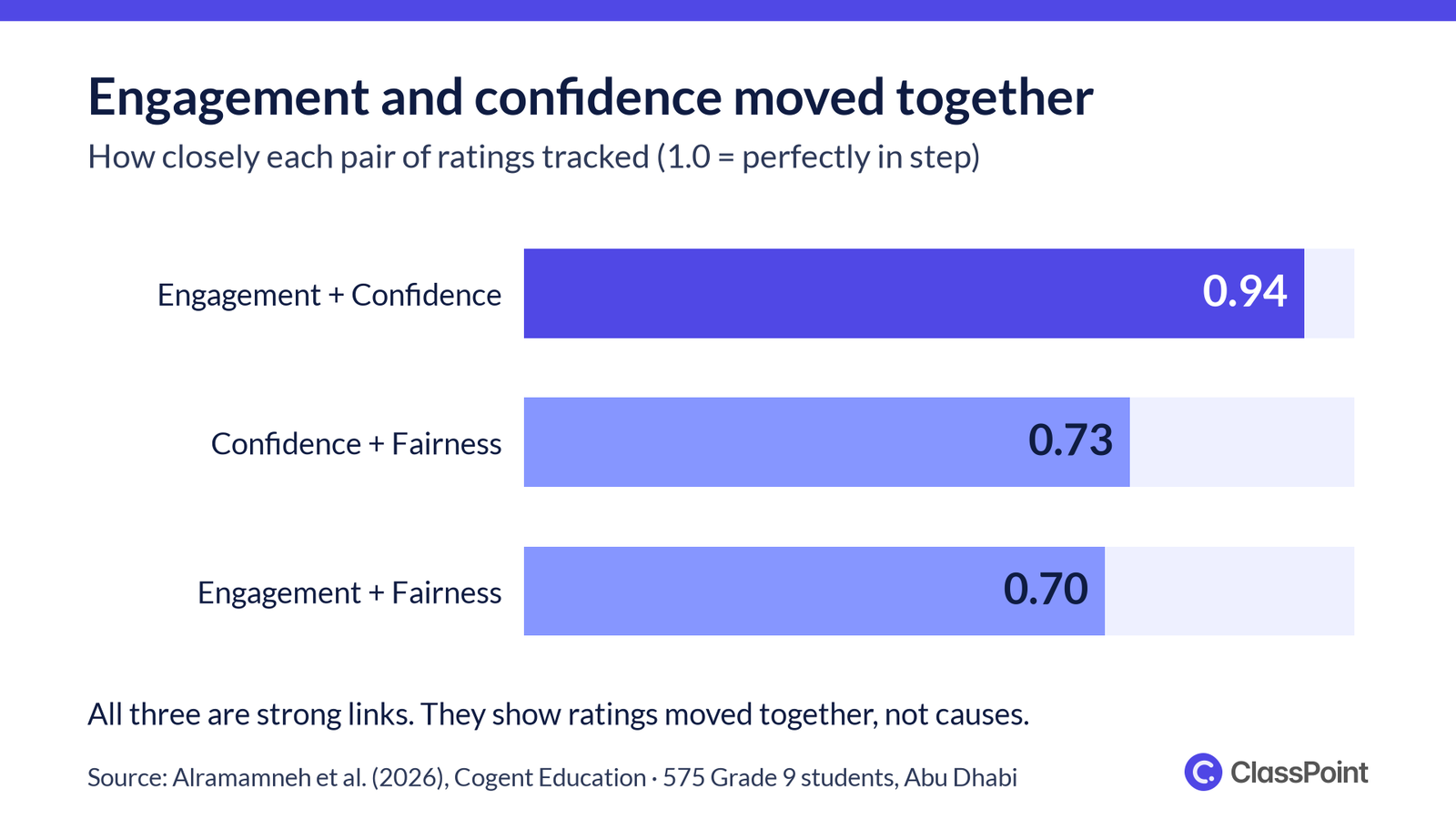
The authors read this as a sign that low-stakes, gamified questions can make answering feel less risky, because a wrong answer is part of the activity rather than a public moment.
They point out this may matter most in text-heavy subjects like Arabic and Islamic Studies, where fear of getting it wrong in front of classmates keeps hands down. A survey taken at one point in time can’t prove the lessons caused that confidence, and the authors say so. But the pattern is clear.
Our take: engagement and confidence showing up together is what you’d hope to see. A class that’s lively but tense isn’t really working.
Related study: Confidence came up at Qassim University in Saudi Arabia too. In an EFL course, exam anxiety fell further in the ClassPoint group than in a standard PowerPoint group, and a follow-up study found students' confidence rose steadily over a full semester. Read about both Qassim studies
Engaged Doesn’t Always Mean Included
Fairness was still strongly linked to engagement (.70) and confidence (.73), just less tightly than those two were linked to each other. The authors’ point is that inclusion behaves as its own thing. A room can feel busy and energetic while some students still don’t feel they’re getting the same chance as others.
Some of that gap won’t fully close. Students arrive with different confidence levels, and no tool erases that in a term.
But a fair share of it is about lesson design: who sees whose answers, how much time pressure there is, and whether speed or a leaderboard decides who gets noticed. Those are choices a teacher makes, which also makes them fixable.
How to Help Every Student Take Part in ClassPoint
The authors recommend low-stakes questions, more than one way to respond, and less public pressure. Here’s how that looks in ClassPoint.
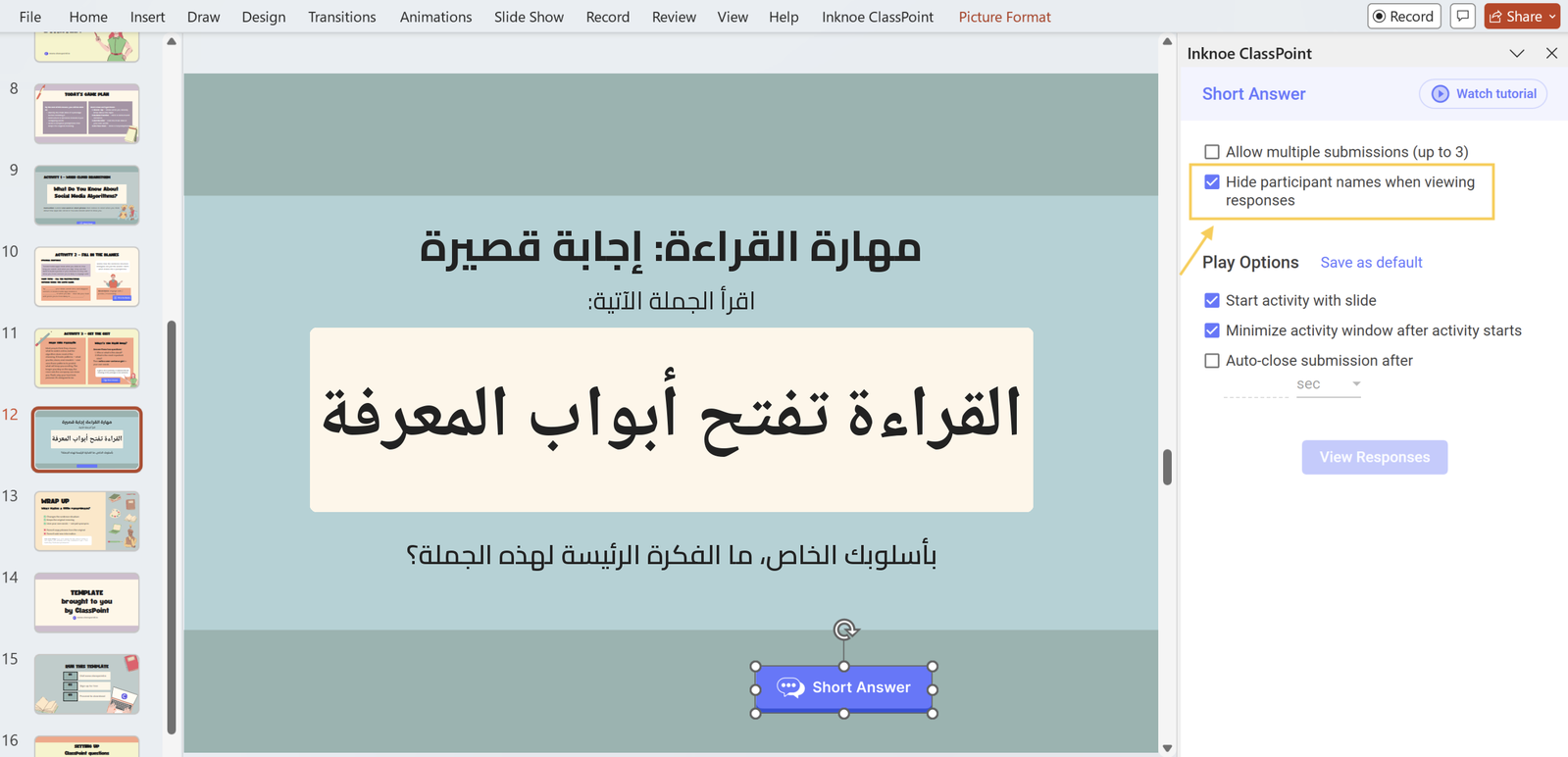
- Hide names when you show answers. In the ClassPoint side panel, tick “Hide participant names when viewing responses” before you run the activity. Students who’d never raise a hand will often still type an answer when the class won’t see whose it is.
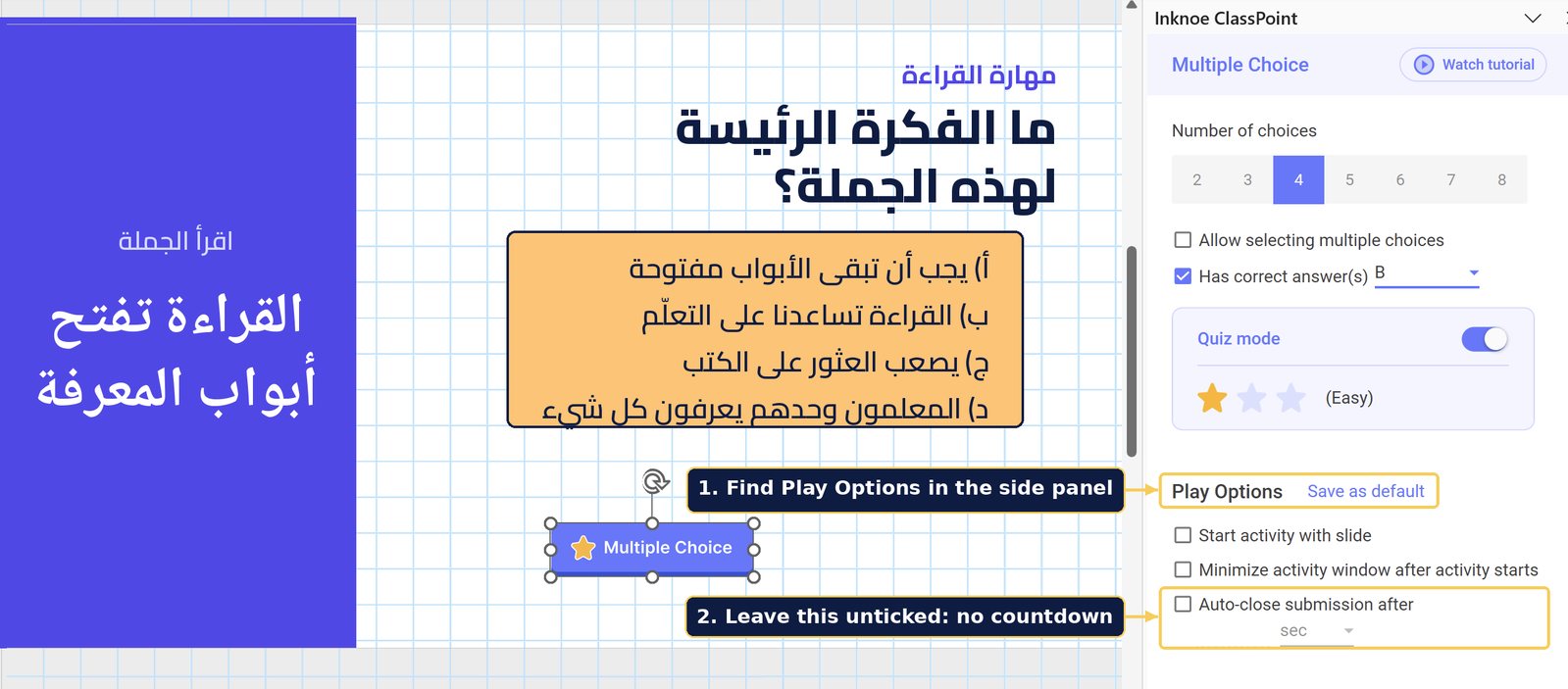
- Run some rounds with no clock and no leaderboard. Countdown timers and the leaderboard are optional. Leave “Auto-close submission after” unticked in Play Options and keep the leaderboard closed when the goal is thinking rather than racing.
- Mix up how students answer. Word clouds, slide drawing and audio recording give students who are less comfortable writing or speaking another way in. The authors mention word clouds, written answers and visual responses by name.
- Ask the class how fair it felt. Every few weeks, run a quick short-answer question with participant names hidden: “Did you get a fair chance to take part today? What would help?” It’s the same question the study asked, and it takes two minutes.
The Bottom Line
Across 17 schools, most students said their ClassPoint lessons held their attention and felt safe to answer in. Fairness was the area with the most room to grow, and it’s also the one teachers can do the most about.
When good lesson design and ClassPoint come together, students get a better learning environment: one where they stay hooked, feel safe to answer, and get a fair turn. Pair them in your next lesson.
