Most students think paraphrasing means swapping a few words for synonyms and moving on. They’ll replace “important” with “significant,” leave the sentence structure untouched, and genuinely believe they’ve done the work.
The problem is, teachers usually don’t find out until days later when graded assignments come back full of shallow rewording instead of genuine comprehension.
If you’ve been searching for paraphrasing activities that actually teach the skill, not just test it, this post walks through four research-backed exercises that build on each other. You can use them as a single paraphrasing lesson or spread them across a week.
Each one comes from published classroom research, and together they move students from activation to independent practice, with the teacher seeing what’s happening every step of the way.
Why Most Paraphrasing Activities Fall Flat
The most common approach to teaching paraphrasing is to hand students a passage and say “put it in your own words.”
The problem is that most students hear this as “change enough words to make it look different.” They swap synonyms, keep the original sentence structure, and produce something that technically uses different vocabulary but demonstrates zero comprehension.
A 2026 peer-reviewed study from Hong Kong Polytechnic University found exactly this pattern:
“Some responses reflected a tendency to prioritize surface-level reformulation over substantive rethinking, particularly when evaluative criteria were not made explicit.” — Har & Sullivan (2026), Applied Language Sciences
In other words, when students aren’t shown what a good paraphrase actually looks like, they default to the safest move they know: swap a few words and hope it’s enough.
The deeper issue is visibility. In most classrooms, teachers assign paraphrasing exercises and only see the results when graded work comes back days later. By then, the misconception has already hardened.
Students who thought synonym-swapping was enough have already submitted a full assignment built on that assumption.
4 Paraphrasing Activities That Build on Each Other
The paraphrasing activities below are structured differently. They follow a progression that makes student thinking visible during the lesson, so you, the teacher, can catch shallow work while it’s still forming and redirect before it becomes a habit.
1. Surface What Students Already Know (Word Cloud Brainstorm)
Before students write anything, find out where they’re starting. Ask them to submit key terms they associate with the topic they’re about to paraphrase. Responses appear as a live word cloud, with the most common terms displayed largest.
This isn’t a paraphrasing exercise on its own. It’s the setup that makes the rest of the lesson work. If students lack vocabulary for the topic, you’ll see it here before it shows up as synonym-swapping in their writing. If they already have a strong grasp, you can skip ahead to scaffolded practice.
Researchers at Hong Kong Polytechnic University used this as the opening step in a paraphrasing sequence with roughly 800 first-year students. Starting with activation let instructors spot vocabulary gaps and assumptions before students attempted any written paraphrasing.
In this example, the topic is about social media algorithms to test initial idea of students on the topic.
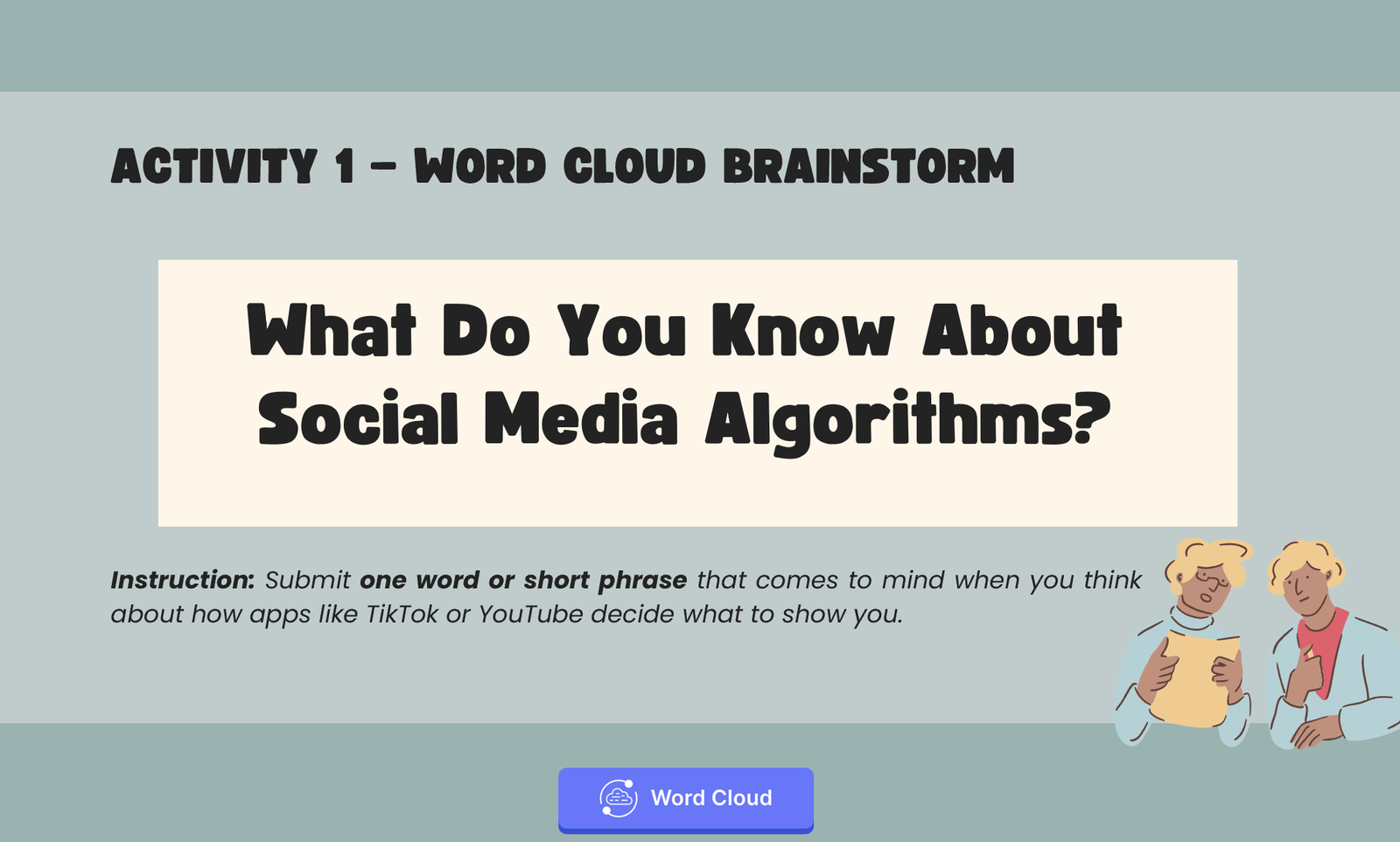
How to run it: If you already teach with PowerPoint, ClassPoint’s Word Cloud is a free add-in that lets every student submit a response from their device at the same time. Results display live on your slide.

Want a ready-to-use version?
The free template covers all 4 activities in a single PowerPoint deck, with interactive ClassPoint quiz buttons already built in.
ClassPoint Paraphrasing Activities
interactive paraphrasing activities in one PowerPoint deck: Word Cloud, Fill in the Blanks, Get the Gist, and full paraphrase with peer review. ClassPoint quiz buttons pre-built. Customizable for any grade or subject.
ClassPoint is a free add-in for PowerPoint that installs in less than 5 minutes. Once it’s set up, you can also use it to run live quizzes, polls, and gamified activities in any lesson, not just this one.
Prefer handwritten? Have students write one key term on a sticky note and place it on the board. Group similar terms together as a class. You’ll get the same snapshot of where students are starting.
2. Practice Restructuring with a Frame (Fill in the Blanks)
The biggest misconception students have about paraphrasing is that it’s about finding different words. It’s not. It’s about changing the structure.
The fill in the blanks activity forces that shift by giving students a partially completed paraphrase and asking them to fill in the gaps.
Show students an original sentence, then display a restructured version with key parts left blank. Students complete the frame. Because the sentence structure has already been changed for them, they can’t fall back on synonym-swapping. They have to work within a new structure and make it make sense.
In the PolyU study, this was the second phase. After activating prior knowledge, students moved into guided practice using sentence frames before they were asked to paraphrase anything from scratch.
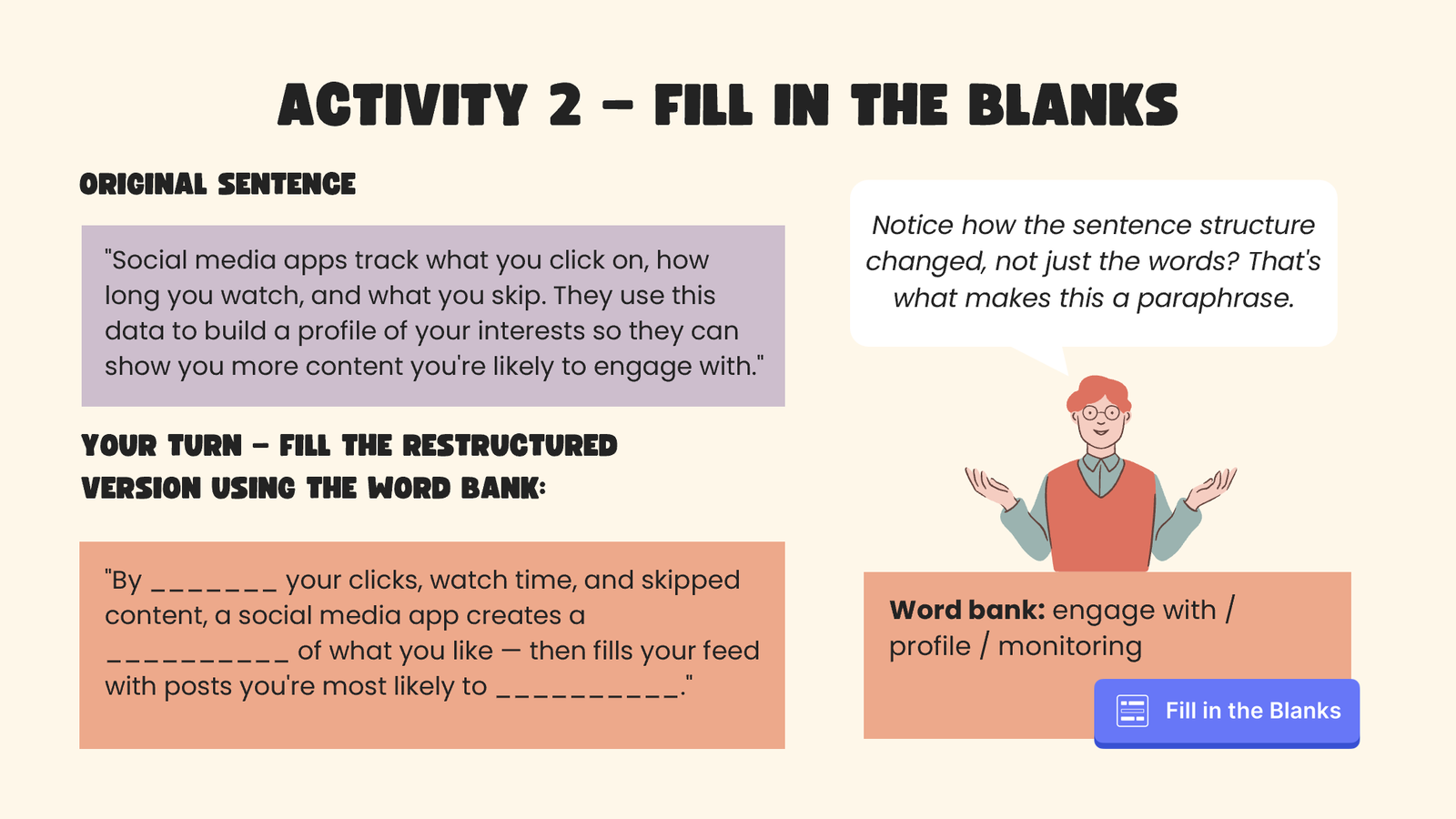
Run it in PowerPoint: ClassPoint’s Fill in the Blanks lets students respond directly on the slide from their own devices. You see every answer as it comes in and can review responses as a class before moving to independent practice.
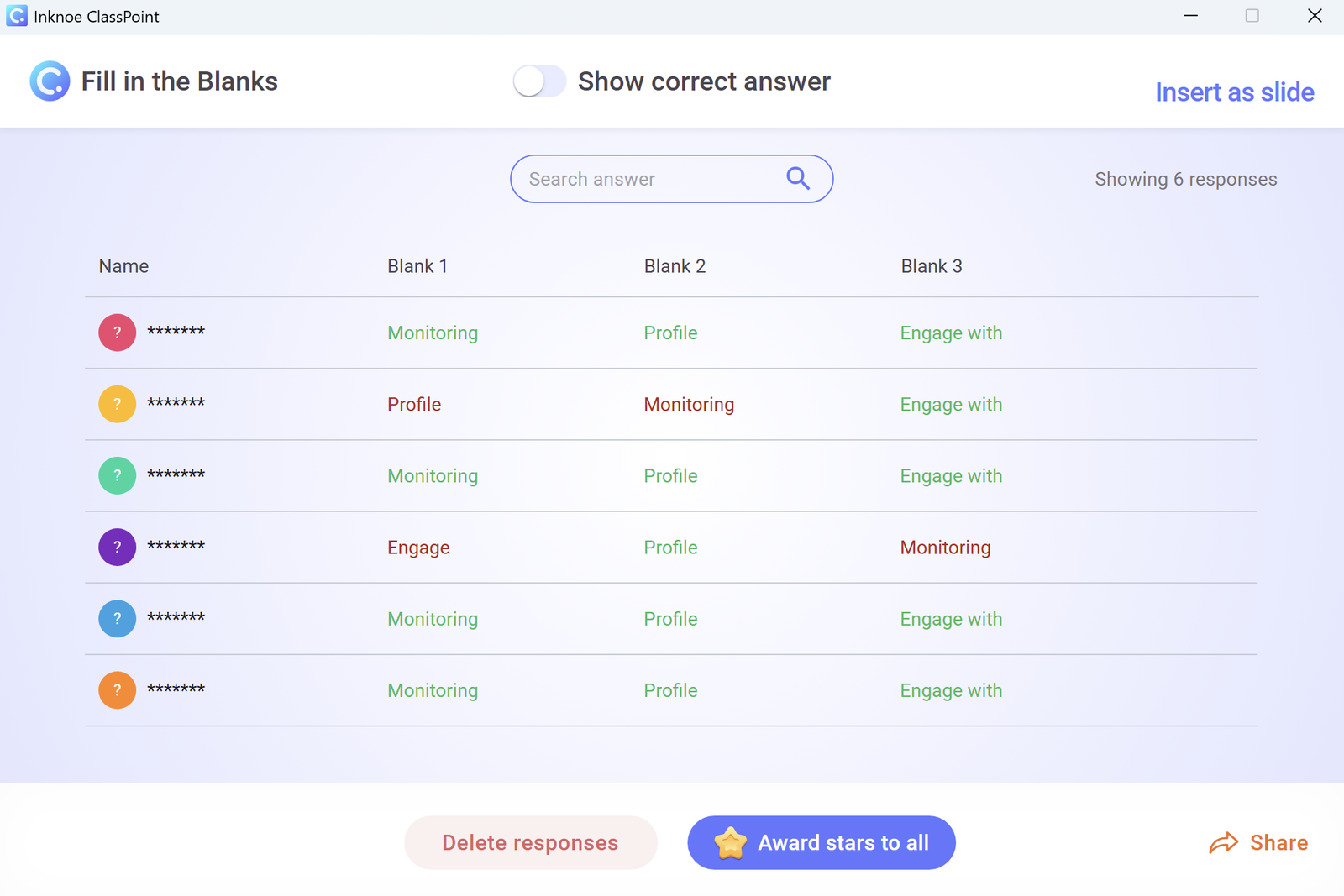
If you prefer this activity without tech, you can print the sentence frames with blanks, or project the original and the frame side by side and have students write their answers on paper.
Want to see the research behind these activities? A peer-reviewed study breaks down what worked, what didn't, and what surprised the instructors. Read the full case study →
3. Identify the Core Idea Before Restating It (Get the Gist)
Before students try to rewrite a passage, make sure they actually understand it. This activity strips paraphrasing back to its foundation: comprehension.
Students read a short passage, then answer two questions: “Who or what is this about?” and “What’s the most important idea about it?” Then they write a one-sentence gist in their own words.
It sounds simple, but it changes what students focus on. Instead of scanning for words to replace, they have to identify what the passage actually means.
A study published in Scientific Studies of Reading tested this approach with grades 4–5 students. Those who practiced “Get the Gist” consistently identified main ideas more accurately than students who didn’t, even on passages they hadn’t seen before.
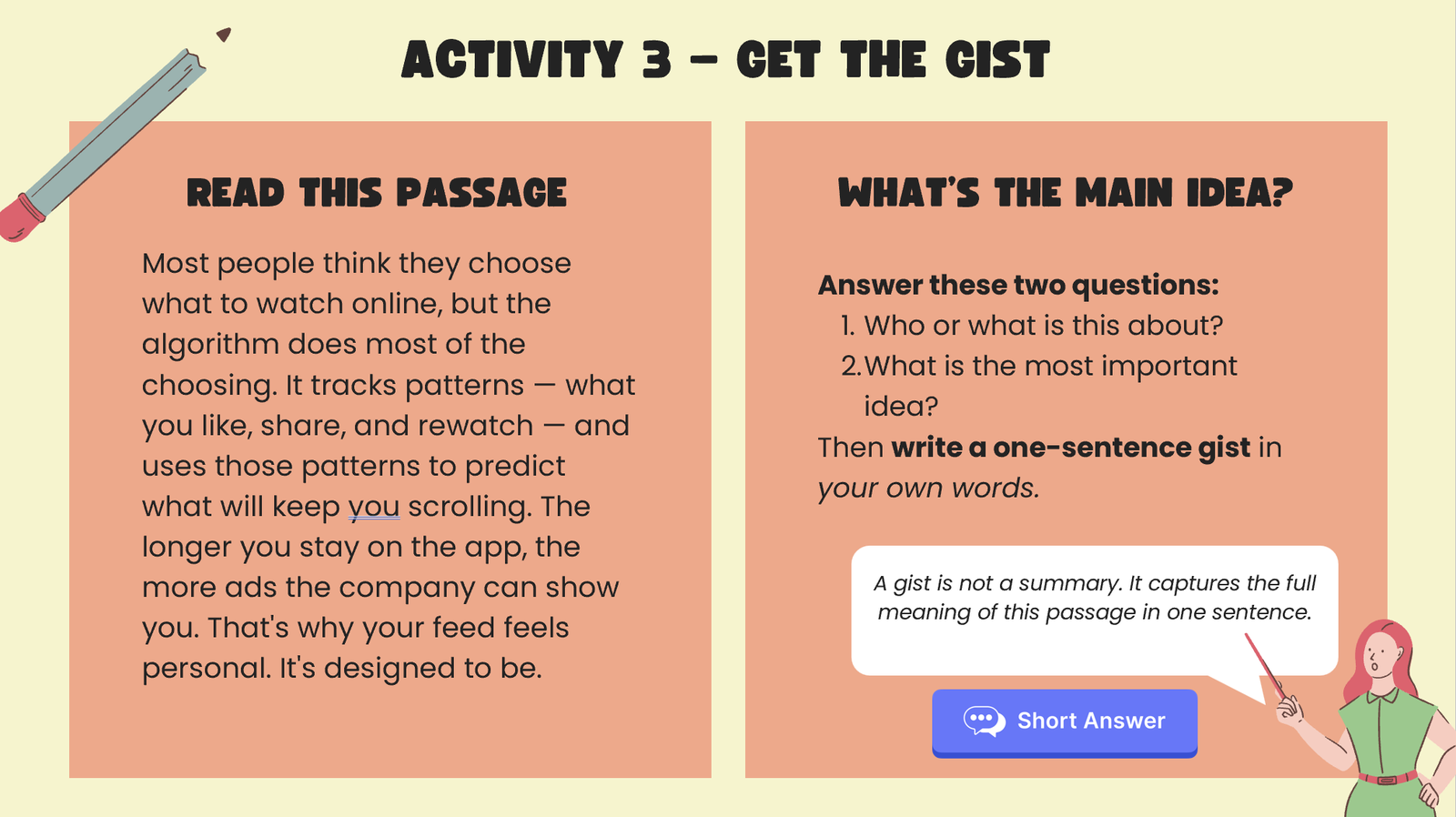
All you need is a passage and a pencil for your students to do this activity. This works as an individual warm-up, a pair activity, or a whole-class discussion.
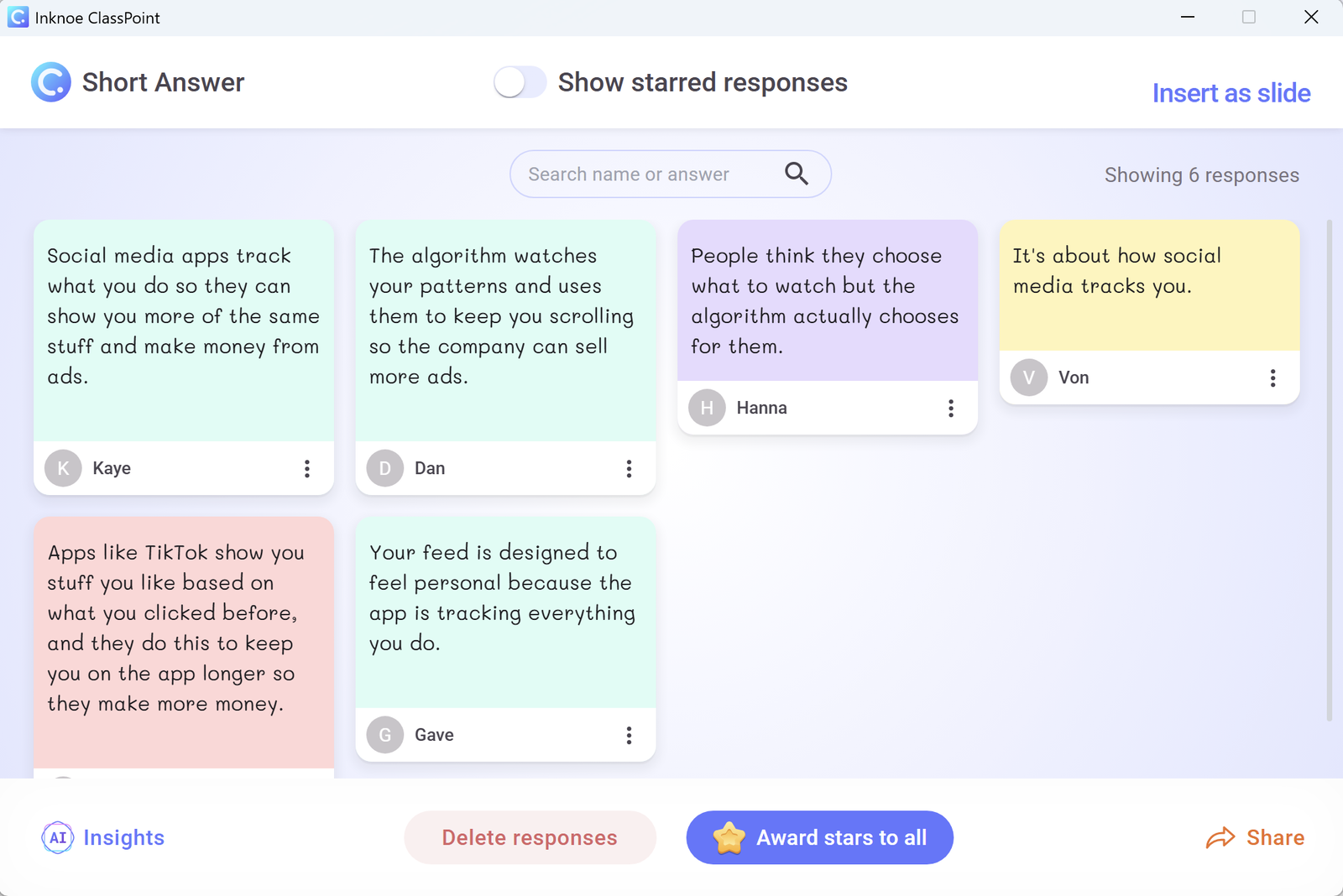
Run it in PowerPoint: ClassPoint’s Short Answer lets you collect every student’s gist at once. Students type and submit from their devices, and you can display responses on screen to compare as a class.
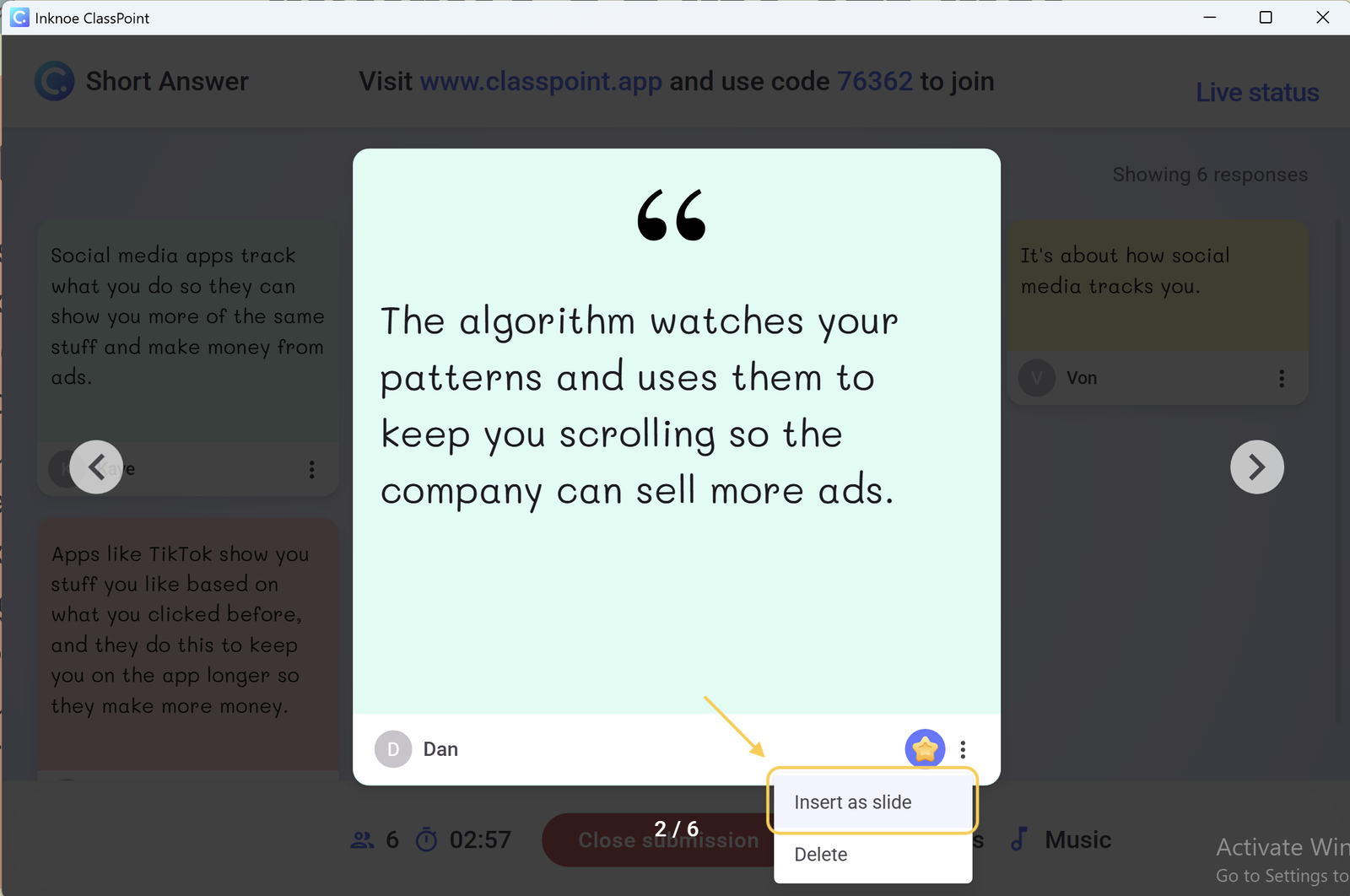
One thing to clarify with students: this is not summarizing. A summary condenses an entire article into a few lines. A gist captures the full idea of one section in a single sentence. The distinction matters because students who skip straight to condensing often lose the meaning they need to preserve when paraphrasing.
4. Write a Full Paraphrase and Get Feedback in Real Time
This is where everything comes together. Students have activated their prior knowledge, practiced restructuring with a frame, and identified the core idea of a passage. Now they write a complete paraphrase on their own.
The key difference from a typical paraphrasing assignment is what happens next.
Instead of collecting papers and grading them days later, the teacher reviews submissions during the lesson. Pick 2–3 responses, display them anonymously, and ask the class: did this one change the structure or just swap words? Did it keep the original meaning? That conversation is where the deepest learning happens.
In the Polytechnic University study, this was the phase where instructors discovered that many students were still defaulting to surface-level rewording, even after guided practice. But because they could see it in real time, they could address it on the spot instead of writing the same feedback on 30 papers a week later.
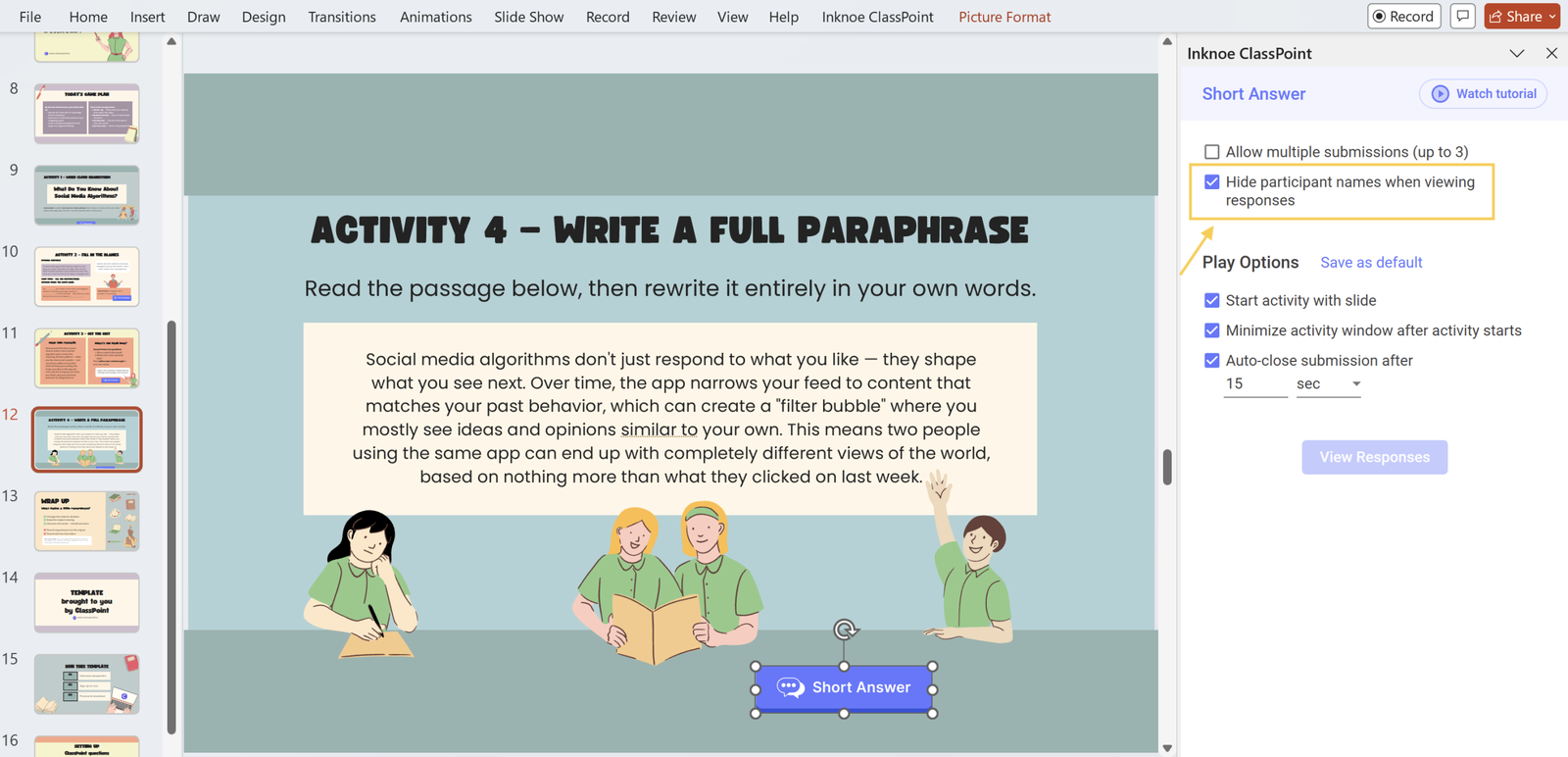
Run it in PowerPoint: Use the same Short Answer setup from Activity 3, but this time responses are displayed anonymously.
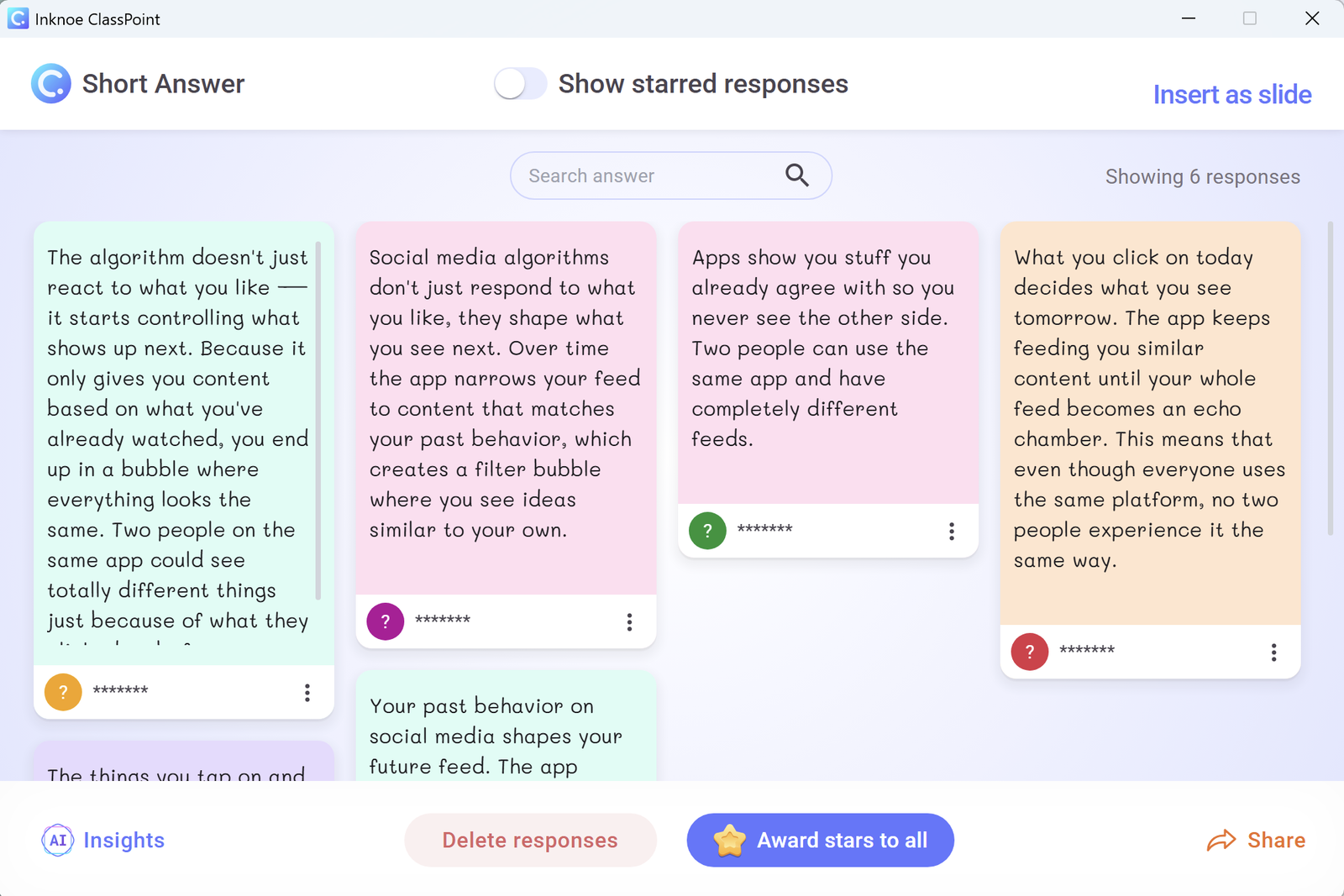
The anonymity matters. In the PolyU study, researchers found that anonymous display changed who participated, quieter students submitted more honest work because their name wasn’t attached to it. Without that, the same confident voices dominate and the students who need the most feedback stay silent.
Prefer analog? Mini whiteboards held up at the same time give you a similar snapshot of the room. You can also have students submit on paper and sort responses under a document camera.
After the Activities: What to Do with What You See
Now you have a live view of how every student is thinking. That’s your check for understanding. Here’s what to do with it:
- Compare examples as a class. Pick 2–3 anonymous submissions and put them side by side. Ask students: which one changed the structure? Which one just swapped words? Which one kept the original meaning? Let them evaluate before you tell them.
- Name what good paraphrasing looks like. After the comparison, make it explicit. Students need to hear the criteria after they’ve seen it in action, not before.
- Use it to plan your next move. The responses you collected are a snapshot of the whole room. If most students restructured well, move on. If half the class is still synonym-swapping, that’s your next lesson.
Whether you use tech or sticky notes, the tool only handles collection. The part that actually changes how students paraphrase is what you do next: choosing the right examples, asking the right questions, and showing students what good looks like while the thinking is still fresh. No tool does that part for you.
FAQ
Why do students just swap synonyms instead of paraphrasing?
Because nobody taught them that structure matters more than word choice. When the only instruction is “put it in your own words,” the fastest move is a thesaurus. Students need to see what structural change looks like before they can produce it on their own.
How do I teach paraphrasing to ESL students?
Start with oral paraphrasing before written, and use sentence frames so students can practice structure without getting stuck on vocabulary. The PolyU study in this post was conducted with L2 learners paraphrasing in English, and the scaffolded progression worked. For more ideas, see these interactive ESL activities with free PowerPoint templates.
How do I teach paraphrasing without students plagiarizing?
Reframe it as a comprehension skill, not plagiarism avoidance. Teach students to read, put the source away, and write from memory. If they can’t restate the idea without looking at the original, they haven’t understood it yet.
Should students use AI tools to paraphrase?
Not for the actual writing, that skips the thinking. A better use: have students evaluate an AI-generated paraphrase against criteria like structure, meaning, and accuracy. They still need to understand the original to judge whether the AI got it right.
