
 Summary

* Expanded from a single classroom trial to adoption across Safa British School's entire primary phase
* 98% of pupils enjoy lessons with ClassPoint, while 97% report feeling more engaged during lessons
* 91% of teachers report higher pupil engagement and regular use across primary classrooms
* Rewards and gamification helped reinforce participation, with 95% of pupils finding them motivating
* Integrated into existing PowerPoint-based teaching routines and supported through ongoing CPD
Safa British School in Dubai wanted to create more participatory primary classrooms where every pupil had opportunities to contribute and learning could be made visible in real time. Rather than introducing a completely new way of teaching, the school looked for an approach that could strengthen engagement, support formative assessment, and fit naturally within existing classroom practice.
Today, ClassPoint is used across the primary phase to support participation, discussion, and real-time insight into pupil understanding. This case study explores the challenges the school set out to address, how implementation evolved, and the impact reported by both staff and pupils.
Background
| Location | Dubai, United Arab Emirates |
| School Type | British Curriculum International School |
| Students | 1,700 |
| Scope | Primary Phase |
| ⭐ Key Features Used | Interactive Quizzes, Rewards, Name Picker, Word Clouds, Short Answer, Fill-in-the-Blanks, Slide Drawing, Instant Polls, and Whiteboard |
Safa British School in Dubai is a British-curriculum international school with a modern learning culture and high expectations. During the initial ClassPoint trial in the primary phase, staff already taught through Microsoft PowerPoint, so any new approach had to work inside existing routines, not ask teachers to start again.
Chris Costello, a Primary Teacher with 11 years’ experience, introduced ClassPoint in his classes and shared the positive outcomes with school leadership. Following clear evidence of impact, Safa implemented the approach across the primary school with structured CPD support.
For Chris, the decision to continue was straightforward: he could strengthen participation and make learning more visible without leaving the slides his colleagues already used every day. That low-friction fit is what made a primary-phase rollout realistic, not a new platform to learn, but a way to teach differently inside familiar lessons.

“ClassPoint has genuinely changed the atmosphere in lessons. Students are more engaged, more involved, and more excited to learn — and as a teacher, that makes a huge difference every day.” Chris Costello, Primary Teacher, Safa British School, Dubai
Challenge
At Safa British School, primary lessons often looked engaged from the front, until you noticed who was doing the talking. Participation tended to cluster around the same confident volunteers, while other pupils stayed quiet even when they had strong ideas.
Costello describes one of the biggest challenges as sustaining engagement across the whole lesson while ensuring every child had a voice, not only those quick to raise a hand. The school wanted to move beyond that pattern and create more opportunities for every pupil to participate, respond, and contribute with confidence.
The school wanted to create classrooms where more pupils participated, teachers could see understanding as it developed, and discussions encouraged students to build on one another’s thinking rather than simply provide answers. At the same time, any change needed to fit existing teaching routines. Primary teachers at Safa already delivered lessons through PowerPoint, so the challenge was educational first:
- Strengthening formative assessment without adding unnecessary complexity
- Ensuring every student had a voice during lessons
- Making learning and understanding visible in real time
- Encouraging richer classroom discussion and collaboration
Approach and implementation
Chris Costello’s rollout began with a trial, not a whole-school plan. After seeing ClassPoint at Deira International School, he tested it in his own primary classes because it matched how Safa already taught.
“What stood out to me was how naturally it fitted into teaching without adding unnecessary complexity. We already use PowerPoint for our slides, so it was the perfect add-on for us.”
When more pupils took part and understanding became clearer during the lesson itself, he shared that evidence with school leadership. They scaled the approach across the primary phase, backed by CPD through webinars, PD sessions, training videos, in-app examples, and shared classroom ideas. The aim was always purposeful use, stronger participation and visible learning, not technology for its own sake.
In practice, this led to several noticeable changes in the classroom:
- Every child could respond simultaneously, rather than waiting to be chosen.
- Pupils collaborated and discussed responses together, creating more opportunities for participation.
- Teachers could see whole-class understanding in real time.
- Learning became more visible, making it easier to identify misconceptions early and address them before moving on.
- Quieter learners found a more accessible route into classroom conversations.
“It helps students explain, discuss, and develop their thinking in a really engaging way.”
That focus on talk and language matched one of Safa’s core primary priorities. For Costello, the value was practical: a way to support oracy and responsive teaching inside the PowerPoint workflow staff already used.
Adoption across the primary phase took time to embed. Device access varied by room, so the school paired rollout with ongoing CPD, shared classroom examples, and steady alignment with existing culture — including linking ClassPoint points to Safa’s house point system, so the approach felt familiar to pupils and staff. Over time, use spread across all primary year groups and subjects as colleagues saw what worked in each other’s classrooms and built it into their own practice.
Related: Hand-raising and who gets called on can skew participation even in engaged classes. Identifying teacher bias and improving classroom fairness walks through patterns and tools that support more balanced responses.
Impact
Internal survey data and classroom observations pointed to the same shift across Safa’s primary phase: more pupils taking part, stronger in-lesson engagement, and adoption that stuck.
| Impact area | What changed | Proof |
|---|---|---|
| Pupil engagement | Lessons felt more interactive; pupils contributed more willingly | 98% enjoy ClassPoint lessons; 97% feel more engaged; 4.86/5 enjoyment rating; pupils’ top word: “Fun” |
| Participation & voice | More pupils contributed, including quieter learners | 97% prefer lessons with ClassPoint; 91% of teachers report higher pupil engagement |
| Formative assessment | Teachers gained clearer whole-class insight during the lesson | 91% of teachers use ClassPoint regularly; staff report immediate visibility of pupil thinking and in-lesson AFL |
| Motivation & culture | Rewards reinforced participation without feeling bolted on | 95% of pupils find rewards motivating; 4.21/5 for motivation through rewards; ClassPoint points aligned with house points |
| Staff adoption | Use spread confidently across primary | 91% enjoy using ClassPoint; 91% say rewards motivate pupils; staff’s top word: “Interactive” |
“Students have responded incredibly positively. They genuinely enjoy the interactive aspects of lessons and especially love the gamification features. The points and rewards system has created a really positive buzz around participation and effort in the classroom.” — Costello
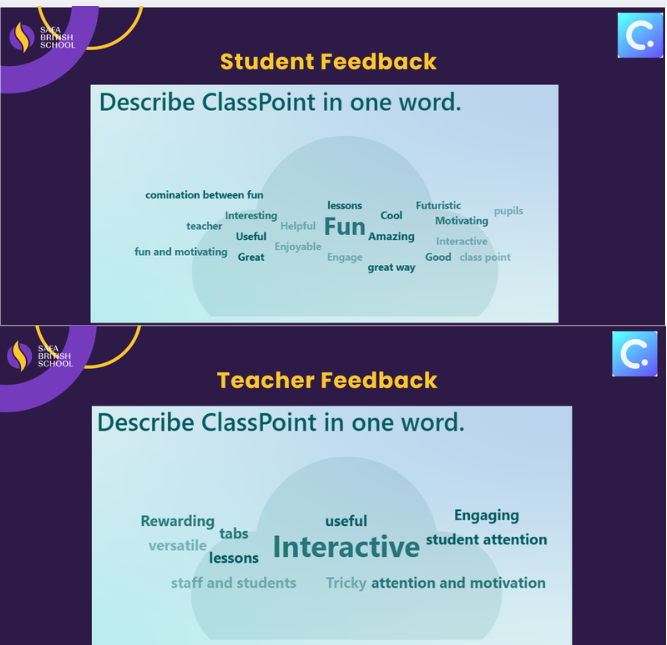
Pupil and teacher feedback reinforced the survey data: greater confidence without raising a hand, more chances for everyone to participate, and staff reporting stronger engagement during the kind of in-lesson checks for understanding they already planned around retrieval and plenaries.
New to ClassPoint? Visit our tutorial hub to learn how to use interactive quizzes, name pickers, polls, AI tools, and other features to increase classroom engagement.
Student and teacher voices
The survey findings were reflected in everyday classroom experiences. Students described feeling more confident to participate and share their thinking, while teachers highlighted improved engagement, visibility of learning, and more immediate feedback during lessons.
Student voices
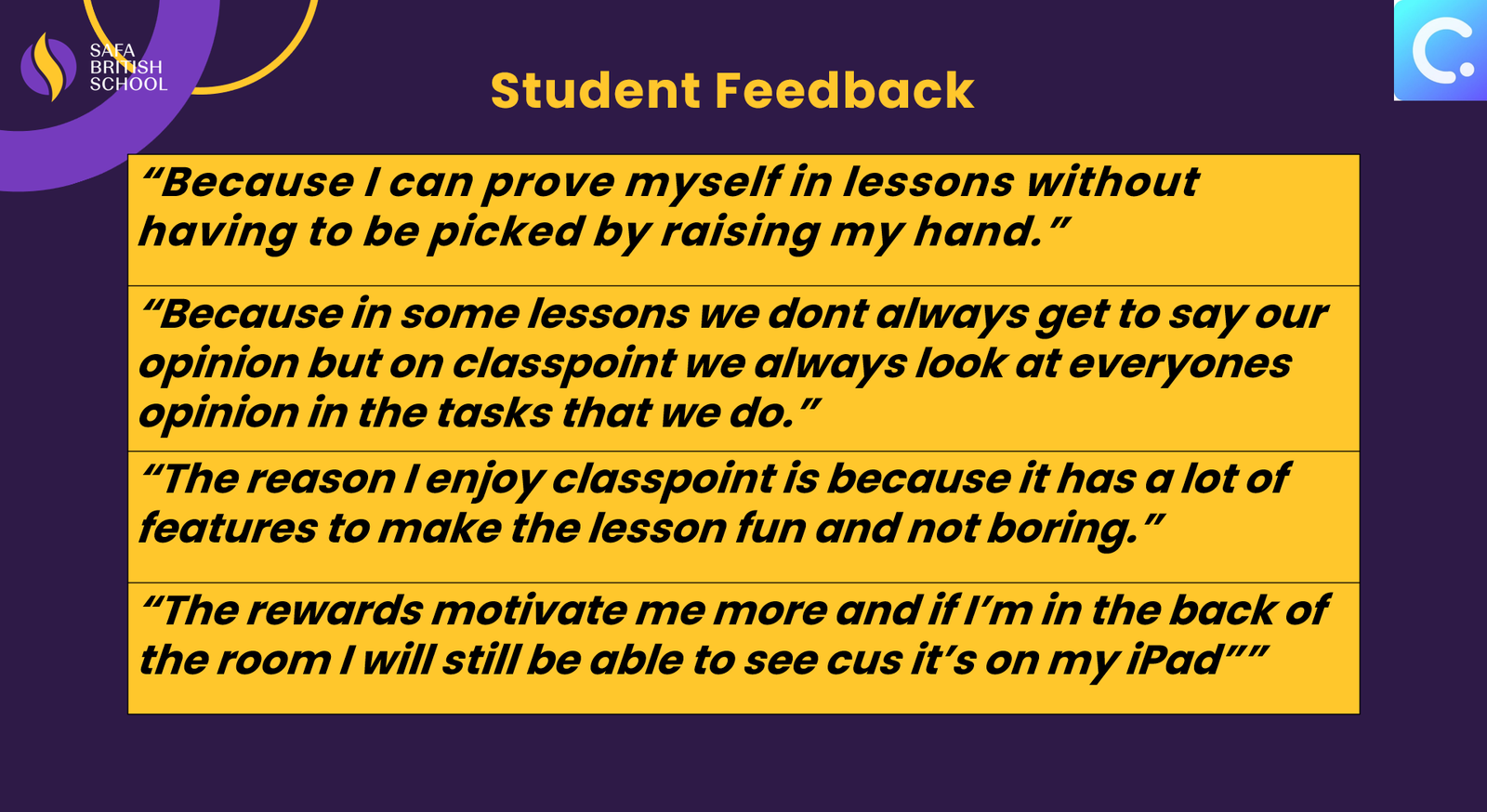
“Because I can prove myself in lessons without having to be picked by raising my hand.”
“Because in some lessons we don’t always get to say our opinion, but on ClassPoint we always look at everyone’s opinion in the tasks that we do.”
“The reason I enjoy ClassPoint is because it has a lot of features to make the lesson fun and not boring.”
“The rewards motivate me more and if I’m in the back of the room I will still be able to see because it’s on my iPad.”
Teacher voices
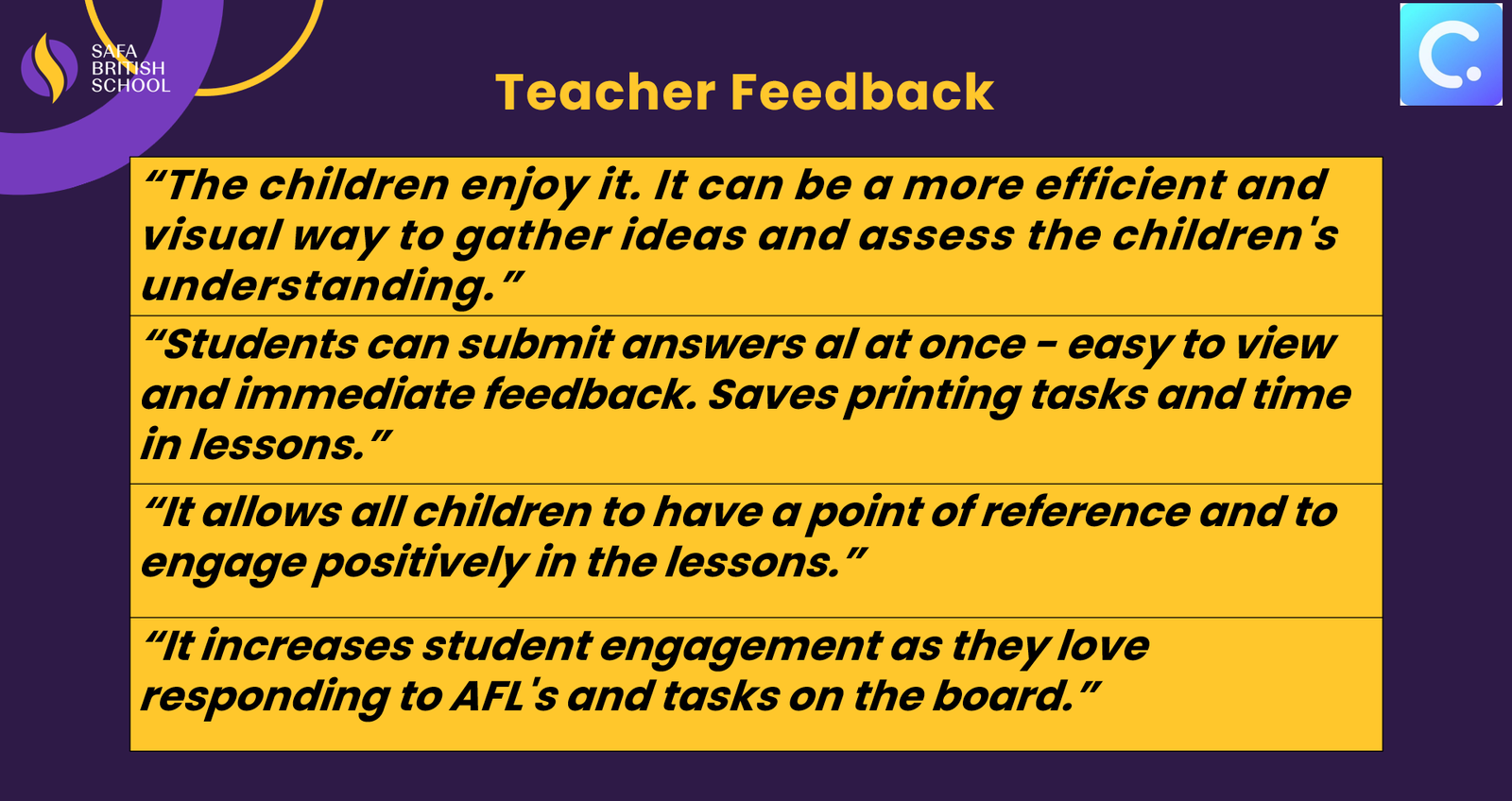
“Students can submit answers all at once — easy to view and immediate feedback. Saves printing tasks and time in lessons.”
“It allows all children to have a point of reference and to engage positively in the lessons.”
“It increases student engagement as they love responding to AFL’s and tasks on the board.”
“The children enjoy it. It can be a more efficient and visual way to gather ideas and assess children’s understanding.”
Conclusion
Safa British School’s primary phase rollout shows how school-wide adoption succeeds when tools fit existing practice. End-of-term surveys recorded high levels of teacher adoption, pupil enjoyment, and engagement, outcomes that endured because implementation layered onto PowerPoint rather than asking staff to change how they taught.
Across year groups, Interactive Questions, Quiz Mode, and Rewards & Stars, aligned with the school’s house point system, helped deepen participation, make thinking visible in real time, and strengthen formative assessment within everyday lesson routines. Ongoing CPD and shared classroom practice carried that momentum from early trials to consistent use across the primary phase.
For schools already teaching through slides, the lesson is straightforward: sustainable impact comes when interactive tools strengthen participation and assessment within workflows teachers already trust, then scale through purposeful training, shared practice, and alignment with school culture.
Related Reading:
