Learning in a new language changes everything.
For English Language Learners (ELL), understanding a lesson, joining a discussion, or explaining an idea often requires navigating both academic content and a developing command of English at the same time.
The challenge for teachers is not lowering expectations, but designing instruction that allows students to access learning a language, use English with growing confidence, and participate meaningfully even when their language skills are still emerging.
Well-planned ELL teaching strategies help bridge that gap. They remove unnecessary language barriers while keeping academic expectations high.
In this blog, we will look at what ELL teaching involves, why it matters in real classrooms, and ELL teaching strategies teachers can use to support language growth and participation.
What Is ELL Teaching and Why It Matters

ELL teaching is the practice of supporting students who are learning English while they engage with academic content. It focuses on helping learners understand lessons, communicate ideas, and participate in class as their English skills develop.
Rather than emphasizing grammatical accuracy alone, effective ELL teaching prioritizes comprehension, confidence, and access to learning. Students are given multiple ways to understand content and show what they know, even when their English is still emerging.
At its core, ELL teaching helps students:
✅ Access lessons without relying only on text
✅ Express ideas through speaking, visuals, or short responses
✅ Participate confidently with guided support
✅ Develop language alongside academic learning
Why ELL Teaching Matters
When language support is missing, English Language Learners may appear disengaged or behind despite understanding the content. In these cases, language becomes the barrier, not ability.
Strong ELL teaching creates more equitable classrooms by:
- Increasing access to grade-level content
- Encouraging participation across language levels
- Providing clearer ways to demonstrate understanding
- Supporting long-term language development
To make this possible, ELL teaching must be intentional and practical. The following strategies show how teachers can apply ELL teaching effectively during everyday instruction.
1. Anchor Meaning With Visual Support

For students learning English, words rarely stand on their own. Visuals act as an anchor that helps students attach meaning to language before they are expected to use it.
In practice, visuals should appear before or during explanations, not after. When a teacher introduces a new topic using images, diagrams, or labeled visuals, students can begin forming mental connections even if they do not yet understand every word being said.
Example:
When teaching weather patterns, show images of storms, clouds, and temperature maps while explaining key terms aloud.
2. Combine Listening, Speaking, Reading, and Writing
Language develops faster when students encounter it repeatedly in different forms. A lesson that relies on only one mode limits opportunities for processing.
Rather than separating language skills into different activities, effective ELL teaching layers them naturally into a single lesson flow.
Example lesson flow:
- Students listen to a short explanation with visuals
- They read a brief sentence or prompt
- They discuss ideas with a partner using guided language
- They respond with a short written or audio answer
Teachers can also refer to the table below:
| Language Mode | Example Activity |
|---|---|
| Listening | Teacher explains a concept with visuals |
| Reading | Students read a short prompt or sentence |
| Speaking | Partner discussion using guided prompts |
| Writing | Short written or audio reflection |
This approach allows students to reinforce language through repetition and variety.
3. Break Instructions Into Clear, Visible Steps

ELL students often struggle not with the task itself, but with decoding long instructions. When instructions are delivered all at once, students may miss critical steps.
The key is visibility and pacing. Instructions should be shown, not just spoken, and revealed gradually.
Instead of saying all directions verbally, display them on a slide. Reveal one step, model it, and wait until most students complete it before moving on. This reduces confusion and keeps students aligned.
Effective scaffolding includes:
- One instruction at a time
- Visual display of steps
- Teacher modeling before independent work
To put it in practice, teachers should display steps on a slide and reveal them gradually as students complete each part of the task.
4. Model Responses Before Asking for Independent Work
ELL students frequently ask themselves, “What does a good answer sound like?” Modeling removes that uncertainty.
It is not about giving students the answer. It is about showing the structure of thinking and language expected.
Effective modeling includes saying a response out loud, pointing out useful phrases and explaining why the response works.
When students see and hear what success looks like, they are more willing to try.
5. Pre-Teach Vocabulary That Carries Meaning

Not every unfamiliar word needs attention. The goal is to focus on words that are essential to understanding the lesson.
A practical approach:
- Select 5 to 7 high-impact words
- Introduce them with images or short scenarios
- Reuse them throughout the lesson
This helps students recognize and apply vocabulary in context.
Need help in introducing vocabulary in your students? Check out 25+ Vocab Activities That Boost Engagement You Can Create With AI.
6. Create Low-Pressure Ways to Participate

Many ELL students remain silent not because they do not know the answer, but because some students feel shy and speaking publicly feels risky.
Low-pressure participation lowers the emotional cost of trying.
This can include:
- Anonymous responses
- One-word or short-phrase answers
- Visual selections instead of spoken explanations
When participation feels safe, students practice language more often.
7. Support Expression With Sentence Frames
Sentence frames act like training wheels for language. They help students focus on ideas while borrowing structure.
The key is to treat frames as a scaffold, not a crutch.
Examples of frames:
- “I agree with ___ because ___.”
- “The main idea is ___.”
- “This happened because ___.”
Over time, frames can be reduced as students become more independent.
8. Check Understanding Beyond Written English
Written English often lags behind understanding. If writing is the only way students show learning, teachers may underestimate what students know.
Checking understanding should separate content knowledge from language proficiency.
| Response Type | What It Reveals |
|---|---|
| Visual choice | Concept recognition |
| Oral explanation | Reasoning and clarity |
| Short response | Key idea understanding |
| Image upload | Concept application |
Using multiple formats gives teachers a fuller picture of learning.
For more ways to check understanding across all learners, not just ELL students, see these 8 classroom strategies that work at any level.
9. Build Background Knowledge Before Introducing New Content

Sometimes confusion comes from unfamiliar experiences rather than language itself. When students lack background knowledge, even simple language can feel complex.
Building context first makes language easier to process.
Before a new topic:
✅ Show a short video or image set
✅ Ask questions tied to familiar experiences
✅ Clarify cultural or contextual references
Once students understand the situation, language has something to attach to.
10. Encourage Structured Peer Interaction

Peer interaction creates natural opportunities for language use, but only when it is structured.
Unstructured group work often benefits fluent speakers more than language learners.
Effective peer interaction includes:
- Clear prompts or questions
- Defined roles in group work
- Time to think before speaking
This allows ELL students to rehearse ideas and language in a safer setting. Students gain confidence by rehearsing ideas with peers first.
11. Reinforce Key Ideas Through Repetition and Variation
For English Language Learners, understanding rarely happens the first time an idea is introduced. Repetition matters, but repeating the same explanation rarely helps. What makes reinforcement effective is variation.
Instead of repeating the same explanation, teachers can reinforce key concepts by changing how students encounter them across a lesson.
| When the Idea Appears | How It Is Reinforced | Why It Helps ELL Students |
|---|---|---|
| Beginning of the lesson | Introduced with visuals or a short explanation | Gives students an initial understanding without heavy language demand |
| Middle of the lesson | Used again in a guided activity or discussion | Allows students to hear and use the language in context |
| End of the lesson | Applied in a short response or reflection | Helps students consolidate meaning and language together |
Each encounter strengthens comprehension while giving students multiple opportunities to connect language with content.
12. Maintain Predictable Lesson Routines
Consistency helps students focus on learning instead of navigating uncertainty.
Predictable routines include:
- Similar lesson flow each day
- Consistent activity types
- Clear transitions between tasks
This structure builds confidence and reduces cognitive load.
Speaking of cognitive load, learn to avoid it in your classroom by reading Cognitive Overload in Students: 5 Strategies to Reduce It.
How ClassPoint Supports ELL Teaching Strategies in Practice
ClassPoint supports effective ELL teaching strategies by embedding language-friendly interaction directly into PowerPoint. This allows teachers to apply ELL teaching strategies during instruction without switching tools or disrupting lesson flow.
Below are the ClassPoint features that directly support ELL teaching:
🖼️ Image Upload
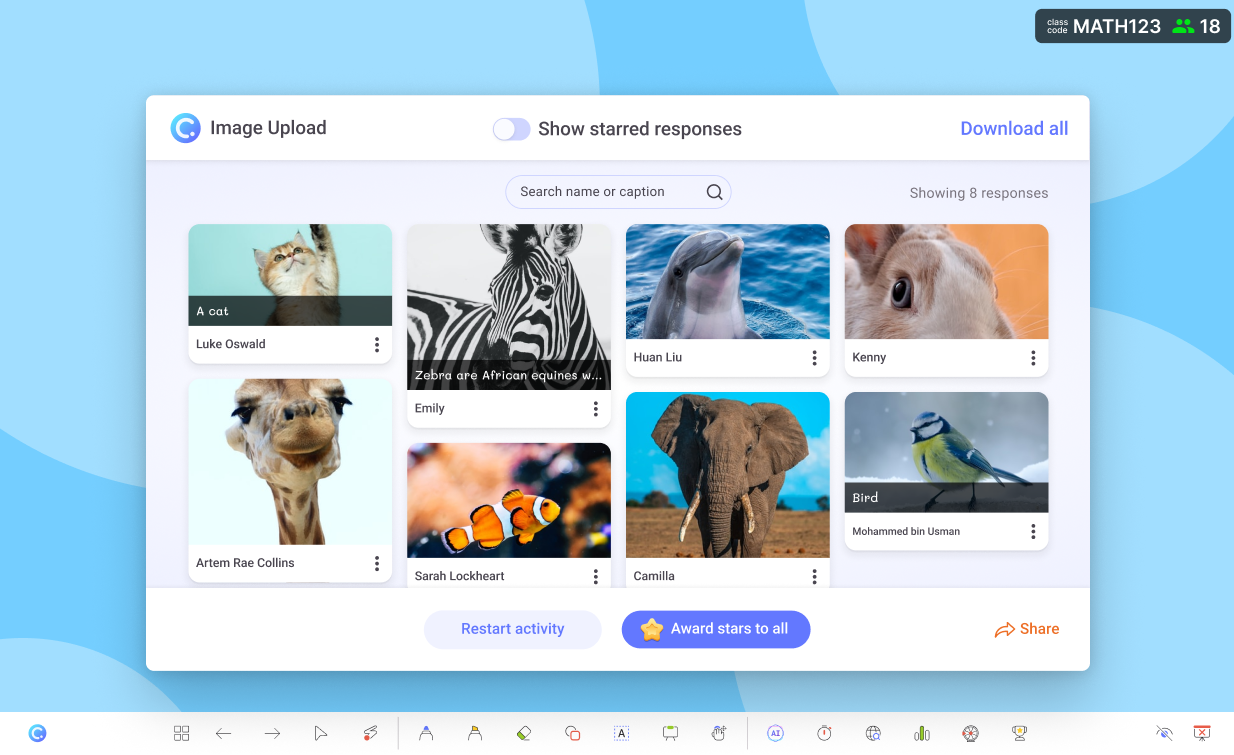
What it supports: Visual comprehension, non-verbal expression
Image Upload activity allows students to respond using visuals instead of relying only on written English. This is especially helpful when students understand a concept but lack the language to explain it fully.
Aside from Image Upload, students can engage in the classroom in non-written ways through:
📣 Audio Record gives students a way to practice spoken English without the pressure of speaking in front of the class
📹 Video Upload allows teachers to bring short, focused videos directly into a slide, giving ELL students essential context before language-heavy instruction begins.
🖍️ Slide Drawing allows students to draw directly on slides to show understanding. This is especially useful when students grasp an idea but do not yet have the language to explain it clearly in English.
Why These Matter for ELL Teaching
Effective ELL teaching depends on consistent execution during live lessons. By offering visuals, flexible responses, and low-pressure participation inside PowerPoint, ClassPoint helps teachers apply ELL teaching strategies naturally, without adding extra platforms or complexity.
FAQs
What are the most common mistakes teachers make with ELL teaching strategies?
One common mistake is simplifying content instead of supporting language. Effective ELL teaching strategies keep academic expectations high while providing scaffolds such as visuals, structured responses, and multiple ways to participate. Another mistake is relying too heavily on written output, which can hide true understanding.
How long does it take for ELL teaching strategies to show results?
ELL teaching strategies often show short-term impact on participation and confidence, while language proficiency develops over a longer period. Teachers may notice improved engagement within weeks, but academic language development typically takes several years with consistent support.
Do ELL teaching strategies only apply in language or ESL classes?
No. ELL teaching strategies are most effective when used across all subjects, including math, science, and social studies. Language development happens best when students use English in meaningful academic contexts throughout the school day.
How can ELL teaching strategies support advanced or long-term English learners?
ELL teaching strategies are not only for beginners. Long-term English learners benefit from strategies that support academic language, such as sentence frames, structured discussion, and opportunities to explain reasoning. These strategies help refine clarity, precision, and confidence in language use.
How do ELL teaching strategies support assessment and grading?
ELL teaching strategies help teachers separate language proficiency from content understanding. By offering multiple ways to demonstrate learning, teachers can assess what students know withoutlanguage becoming the sole measure of success.
How do ELL teaching strategies support culturally responsive teaching?
ELL teaching strategies create space for students to draw on prior knowledge, experiences, and linguistic backgrounds. When instruction values multiple ways of communicating and understanding, classrooms become more inclusive and culturally responsive.
