You’re explaining a concept for the third time. One student is bouncing in their seat. Another avoids eye contact. Someone else hasn’t written a single thing down, yet gives a thoughtful answer when asked privately after class.
Is this disengagement or a different way of processing?
Roughly 1 in 5 students in the United States are neurodivergent in some way. In a class of 30, that’s five or six people whose brains genuinely process information differently. Not slower or worse.
The default lesson format was shaped around a version of the “average student” that was never real, and the gap between wanting to help neurodivergent students and knowing what to change is where most educators get stuck.
This guide covers what neurodivergence looks like in a live session, how to tell accommodation apart from modification, and what to stop doing before adding anything new.
Then we’ll walk through six research-backed strategies that work without overhauling everything.
What Does “Neurodivergent” Mean?
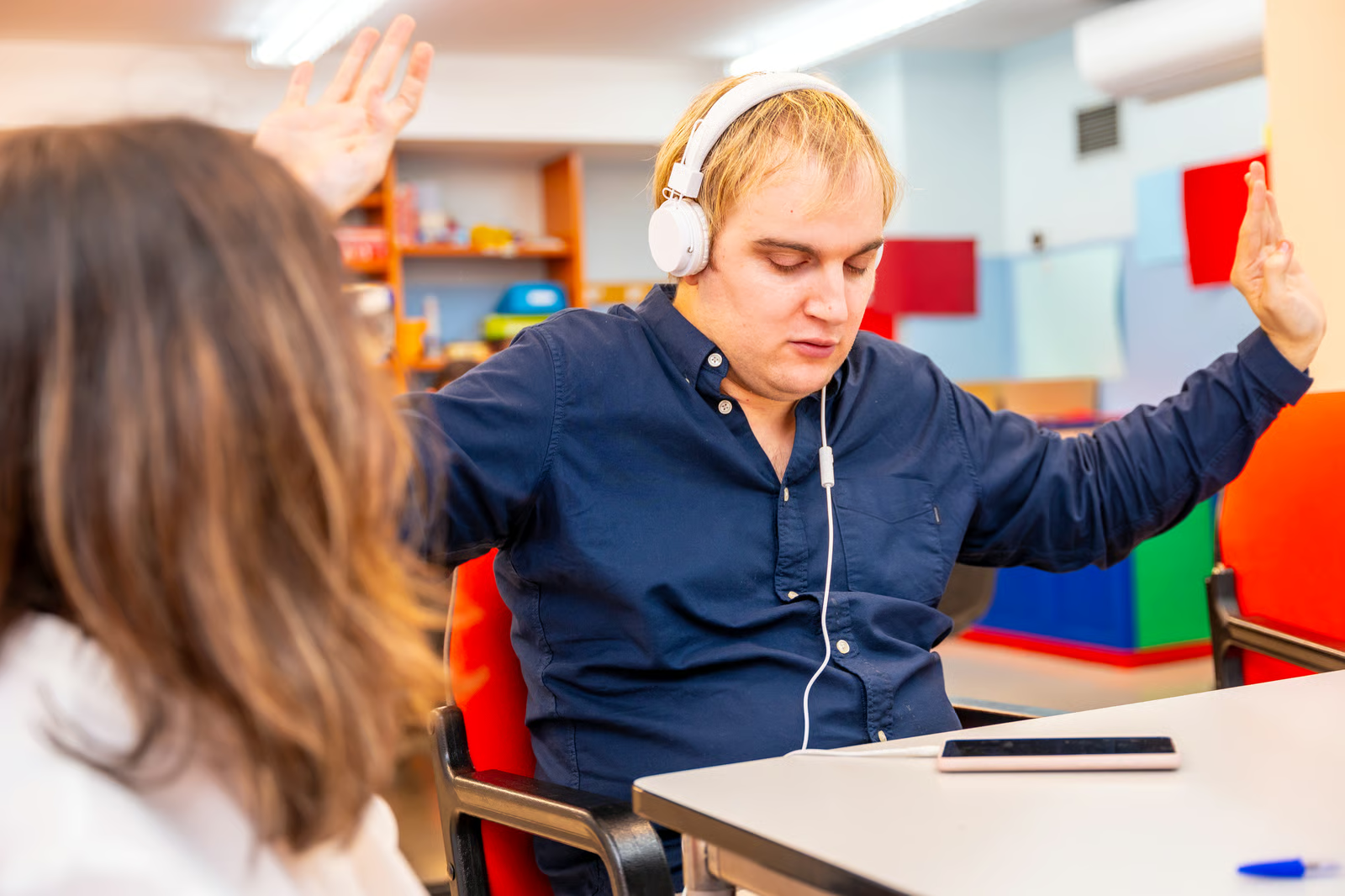
The term neurodivergent covers anyone whose brain works differently from what’s considered neurotypical (typical brain wiring). That includes students with ADHD, autism, dyslexia, dyscalculia, dyspraxia, and sensory processing differences, among others.
These aren’t learning deficits, they’re variations in how a brain routes information.
Many neurodivergent students are sharper, more creative, and more detail-oriented than their peers in specific areas. The friction comes from traditional classroom design asking everyone to receive and demonstrate learning in the same way.
Not every neurodivergent student has a formal diagnosis.
A 2023 UK survey of over 2,000 incoming university students found that more than 14% self-identified as neurodivergent, with researchers noting the actual number is likely higher due to undiagnosed students.
Waiting for an IEP (Individualized Education Program) or formal support plan before adjusting the approach means a significant part of the class falls through the gap quietly.
How These Differences Actually Show Up
The student who won’t make eye contact isn’t disrespectful, and the one who blurts answers isn’t trying to disrupt.
The table below shows what educators often misread and what’s actually going on.
| Type | How It Affects Learning | What You Might See | What Educators Often Misread This As |
|---|---|---|---|
| ADHD | Difficulty with sustained attention and impulse regulation | Restlessness, blurting answers, intense focus during hands-on tasks | Behavioral issues or disinterest |
| Autism | Differences in sensory processing, communication, and social interaction | Sensitivity to noise or visual clutter, preference for routine, deep focus on specific subjects | Inflexibility or being “difficult” |
| Dyslexia | Challenges with reading, spelling, and written language | Slower reading, inconsistent spelling despite strong verbal skills, excelling in discussion | Low effort or poor preparation |
| Dyscalculia | Difficulty with number sense and mathematical reasoning | Anxiety around timed math, struggling with sequences | Math avoidance or laziness |
| Dyspraxia | Challenges with motor coordination and planning | Messy handwriting, difficulty organizing materials, slower task completion | Carelessness |
| Sensory Processing Differences | Heightened or reduced sensitivity to input | Overwhelm from noise or visual clutter, need for movement or quiet to focus | Distraction or lack of discipline |
The Difference Between Accommodation and Modification
Extra time on a test isn’t the same as fewer questions. One changes how students show what they know. The other changes what they’re expected to know.
Accommodation changes how a student accesses or demonstrates learning, without changing the learning goal.
Extra time on a test, submitting audio instead of a written response—these are accommodations.
Modification changes the actual learning goal, like reducing the number of questions because a student finds them hard.
Research from the University of Melbourne and SMART Technologies found that truly inclusive classrooms meet diverse learning needs through flexible access to the same material, not watered-down versions.
Most neurodivergent students need the former.
Sometimes educators overcorrect; in trying to be kind, they lower the bar when the student was fully capable of clearing it.
What to Stop Doing First
Most guides lead with what to do. Here’s what to stop doing first, some of these are genuinely counterproductive even when the intent is good.
Pulling a neurodivergent student aside publicly to offer help.
Research on compassionate pedagogy found that neurodivergent students frequently recalled being highlighted as “different” in school as one of their most lasting negative experiences. It draws attention to the very thing many of these students work hard to keep invisible.
Check in through a private written note or a quiet moment instead.
Treating speed as a proxy for understanding.
Mary Budd Rowe’s research on wait time shows that increasing the pause after a question from one second to three seconds led to more students responding and noticeably better quality answers.
For a student managing a processing delay, that two-second gap is the difference between being seen and being invisible.
Framing support as something “special.”
When flexibility is presented as a carve-out for specific students, using that support starts to feel like a public label.
A 2025 study in Higher Education states that neurodivergent students were far more likely to engage when tools like anonymous response options were offered to the entire group.
6 Ways for Supporting Neurodivergent Learners
Accommodation is about access, not advantage. No need to redesign everything. Small, intentional shifts make the real difference.
These strategies remove unnecessary barriers so neurodivergent students can spend their energy on learning, not coping.
Here’s what we’ll cover:
- Make instructions visible and keep them there
- Offer multiple ways to participate
- Reduce cognitive overload in lesson design
- Build predictability into lessons
- Normalize different learning needs
- Allow processing time without penalty
Each strategy includes specific steps you can try tomorrow.
1. Make Instructions Visible and Keep Them There
When instructions only exist as spoken words, every student has to hold them in working memory while doing the task. For students with ADHD or dyslexia especially, that’s a significant cognitive cost.
Brown University’s Sheridan Center for Teaching and Learning notes that when instructions are only given orally, neurodivergent students can miss them entirely if attention dips even briefly.
Many won’t pick up on the implicit expectations others absorb naturally.
Try this:
| Instruction Strategy | What It Looks Like | Why It Helps |
|---|---|---|
| Display instructions on slides | Task instructions stay on screen so students can reread them | Reduces working memory load and supports students who need more time |
| Break tasks into numbered steps | Assignments shown as short sequential steps, not paragraphs | Makes complex tasks feel manageable and lowers overwhelm |
| Highlight key actions | Words like submit, discuss, or choose one are visually emphasized | Helps students quickly identify what’s required without rereading everything |
| Keep instructions visible during work time | Instructions stay on screen while students work | Lets students self-check progress without needing to ask for help |
This doesn’t slow the class down, it removes the need for students to repeatedly ask what they’re supposed to be doing, which actually saves time.
2. Offer Multiple Ways to Participate

For many students, calling on them to answer aloud creates anxiety before it creates any learning.
The students staying quiet aren’t always the ones who don’t understand. They’re often the ones who understand deeply but can’t perform understanding under those specific conditions.
What the research shows:
That same 2025 Higher Education study reveal that neurodivergent students strongly preferred anonymous digital response tools, polls, and written submissions over face-to-face participation. The anxiety around social exposure itself was the primary barrier, not a lack of knowledge.
One phrase from student interviews said it plainly: “Interactive lessons are great, but too much is too much.”
Here’s multiple ways to encourage participation:
- Anonymous polls where students respond without social risk
- Written submissions from personal devices instead of verbal answers
- Pair sharing before whole-group sharing so students have time to form a thought
- Written reflections submitted after discussion, not during it
When participation stops meaning only speaking, more students start showing up.
The challenge is making this shift without adding complexity to your workflow.
If you’re already using PowerPoint, ClassPoint adds multiple interactive quiz questions directly into your slides. Students join from their own devices at classpoint.app, enter the class code, and participate without leaving their seats. You’ll see their responses in your presentation as they come in.
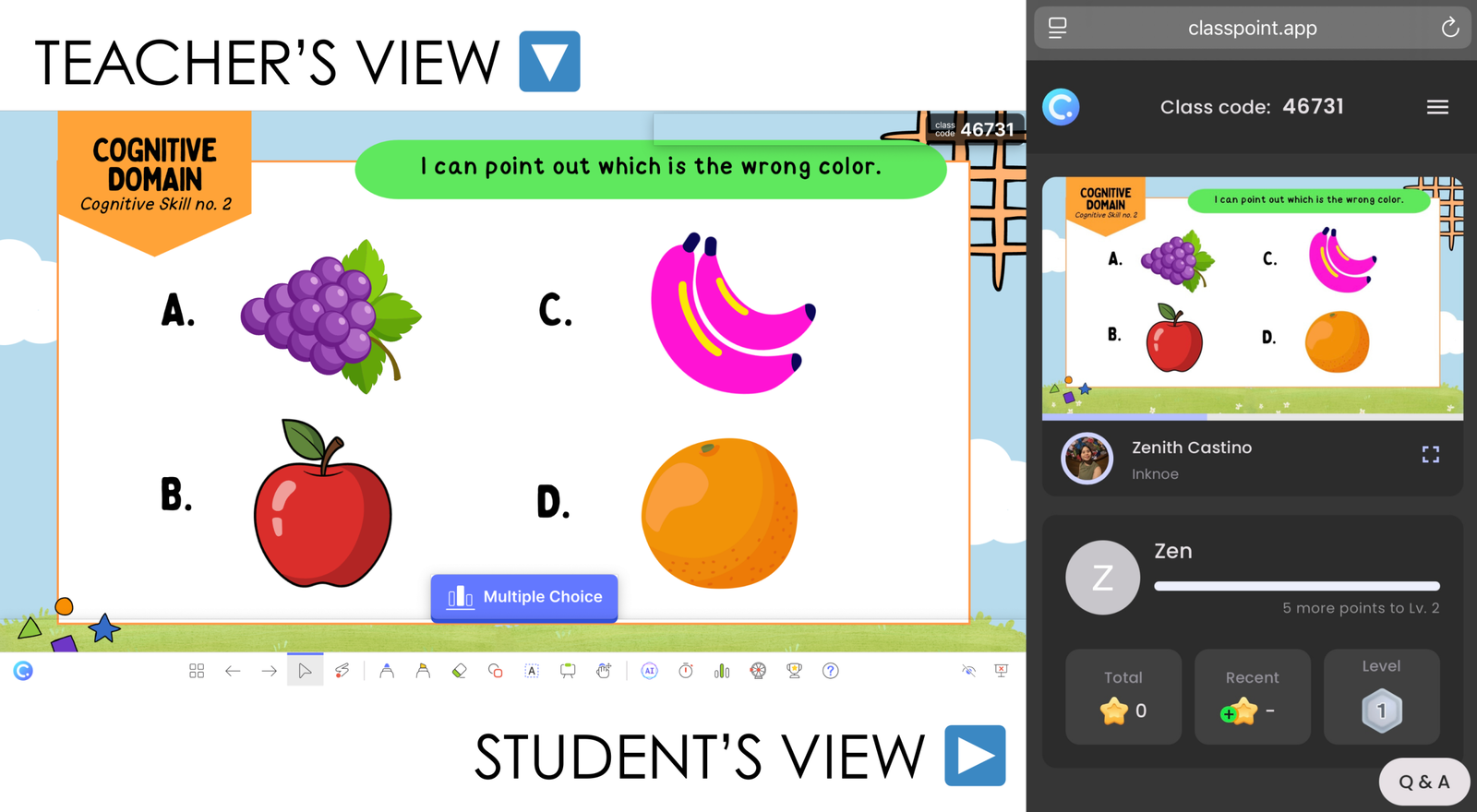
Free tools like Google Forms works too: share a link, students submit from their devices, and responses appear in the form’s Responses tab. Refresh the page to see new submissions.
For neurodivergent students managing anxiety or processing differences, this shift from performance to thinking changes everything. It removes the pressure of being put on the spot, gives ADHD brains a concrete task to focus on, and lets slower processors respond without penalty.
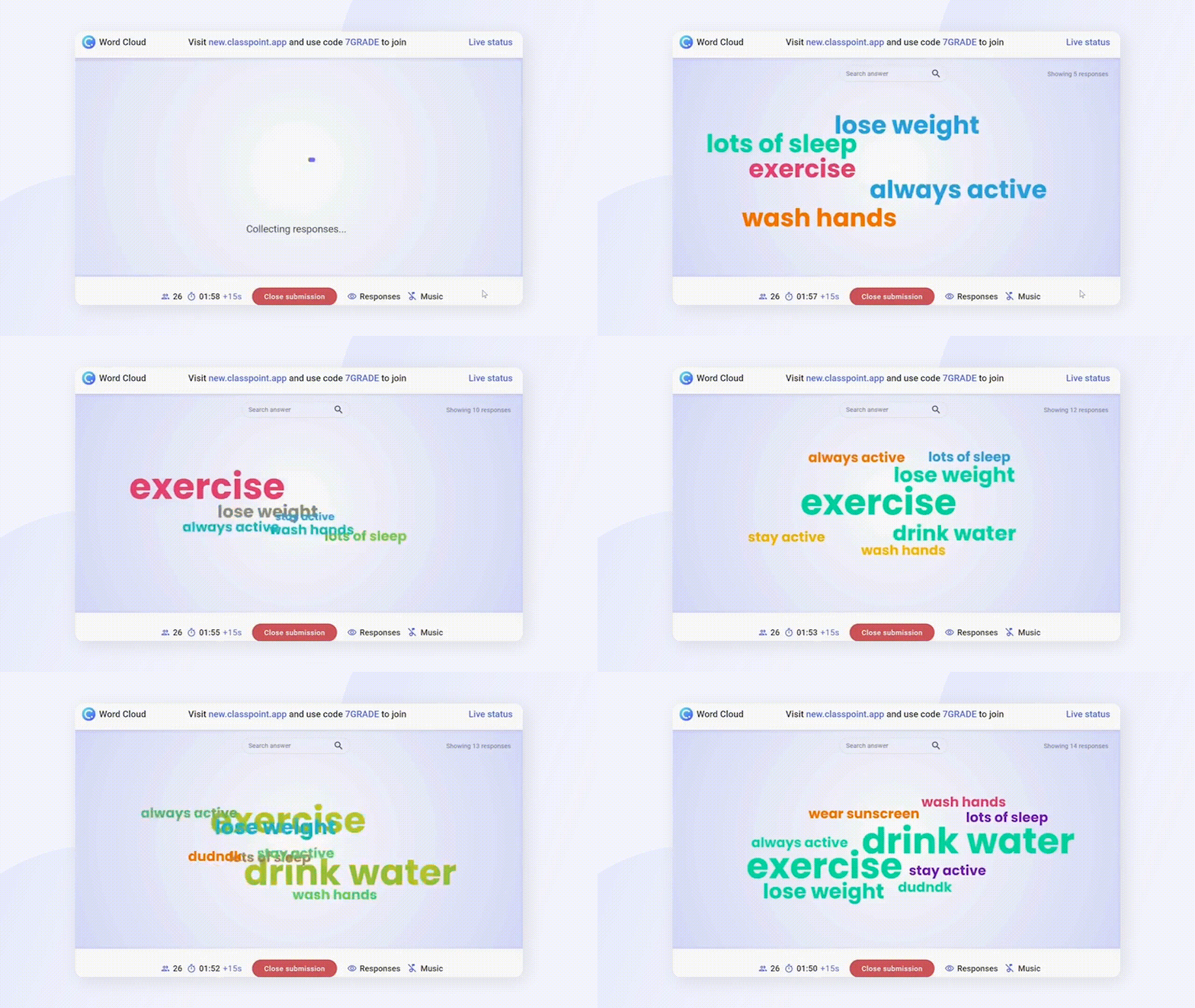
Try Word Cloud, Short Answer, or Quick Poll for anonymous submissions so names stay hidden and ideas surface on their own merit.
| Why Anonymity Helps Neurodivergent Students | How to Use It in Practice |
|---|---|
| Students share honest responses, including uncertainty | Quick understanding checks during or after instruction |
| Reduces anxiety around speaking or being singled out | Polls that surface confusion without embarrassment |
| Lets students engage without masking or avoiding | Open-ended or reflective questions where students respond freely |
In short: When participation means more than just speaking up, more students can show what they know.
3. Reduce Cognitive Overload in Lesson Design
Neurodivergent students often manage significantly more mental input than what’s visible.
A 2024 study in Frontiers in Education found that neurodivergent students regularly use extra mental strategies just to keep up, and this hidden effort often goes undetected by educators. They look fine on the surface. They’re exhausted underneath.
The hidden cost of masking:
Many neurodivergent students expend extra energy trying to appear “normal” in classroom settings, a phenomenon researchers call masking. Combined with sensory stress, this constant effort quietly builds over time and can lead to burnout that’s hard to reverse.
Visual clutter on slides, dense blocks of text, rapid transitions, and constant verbal instructions all compete for attention and energy.
Reducing cognitive load is about simplifying delivery, not content.
In practice:
- One main idea per slide, with no decorative clutter
- Short explanation segments followed by a pause or a low-stakes task
- Consistent transition signals so students aren’t constantly recalibrating
- Avoid reading long text blocks aloud directly from slides
When lessons feel calmer and more predictable, neurodivergent students spend less energy filtering their environment and more on the actual content.
This also benefits students who are tired, anxious, or learning in a second language. Clean lesson design is just good design.
In short: Simpler delivery = more energy for learning. Clean design helps everyone, not just neurodivergent students.
Want to go deeper on this? Read our full guide on "Cognitive Overload in Students: 5 Strategies to Reduce It."
4. Build Predictability Into Lessons
4️⃣ Build Predictability Into Lessons

Uncertainty is cognitively expensive.
The compassionate pedagogy research cited earlier highlights that uncertainty about what’s expected is one of the primary anxiety triggers for neurodivergent students, and it directly impacts attendance and participation before a lesson even begins.
When students don’t know what’s coming next, part of their attention is constantly scanning for surprises rather than focusing on what’s in front of them.
Predictability creates psychological safety.
Start here:
- Share the lesson agenda at the beginning of every session
- Keep activity structures consistent across lessons
- Use a familiar signal before transitions
- Let students know when a task is about to end
Predictability and creativity aren’t in conflict. A predictable structure is what gives the content room to land.
For more on planning with this in mind, backward design for lesson planning is a framework worth looking at.
In short: When students know what’s coming, they can focus on learning instead of scanning for surprises.
5. Normalize Different Learning Needs
When flexibility is built into a lesson for the whole group, support stops feeling like an accommodation and starts feeling like how the class works.
If only one student types their response while everyone else speaks, that student is still marked as different.
If the whole class types their response, it’s just how participation works.
The Universal Design for Learning (UDL) framework from CAST, a framework that gives students multiple ways to engage and show what they know, makes this explicit: When design targets the students who need it most, the experience improves for everyone.
A large-scale review of UDL research found that students consistently showed better academic outcomes when lessons offered multiple ways to engage and respond, compared to traditional instruction.
That holds across age groups and settings.
In practice: every student responds digitally, not just those who need it. Everyone gets access to visual instructions and can choose how to participate when appropriate.
This is the difference between retrofitting inclusion after the fact and designing for it from the start.
Try this:
Many neurodivergent students rely on visual cues, spatial organization, or multimodal input to understand concepts. Not every student thinks in sentences.
ClassPoint allows visual learning with its Image Upload, audio record, and slide drawing directly added to your PowerPoint slides. Students submit from their devices and responses appear in an organized view where you can select which to display or add as slides.
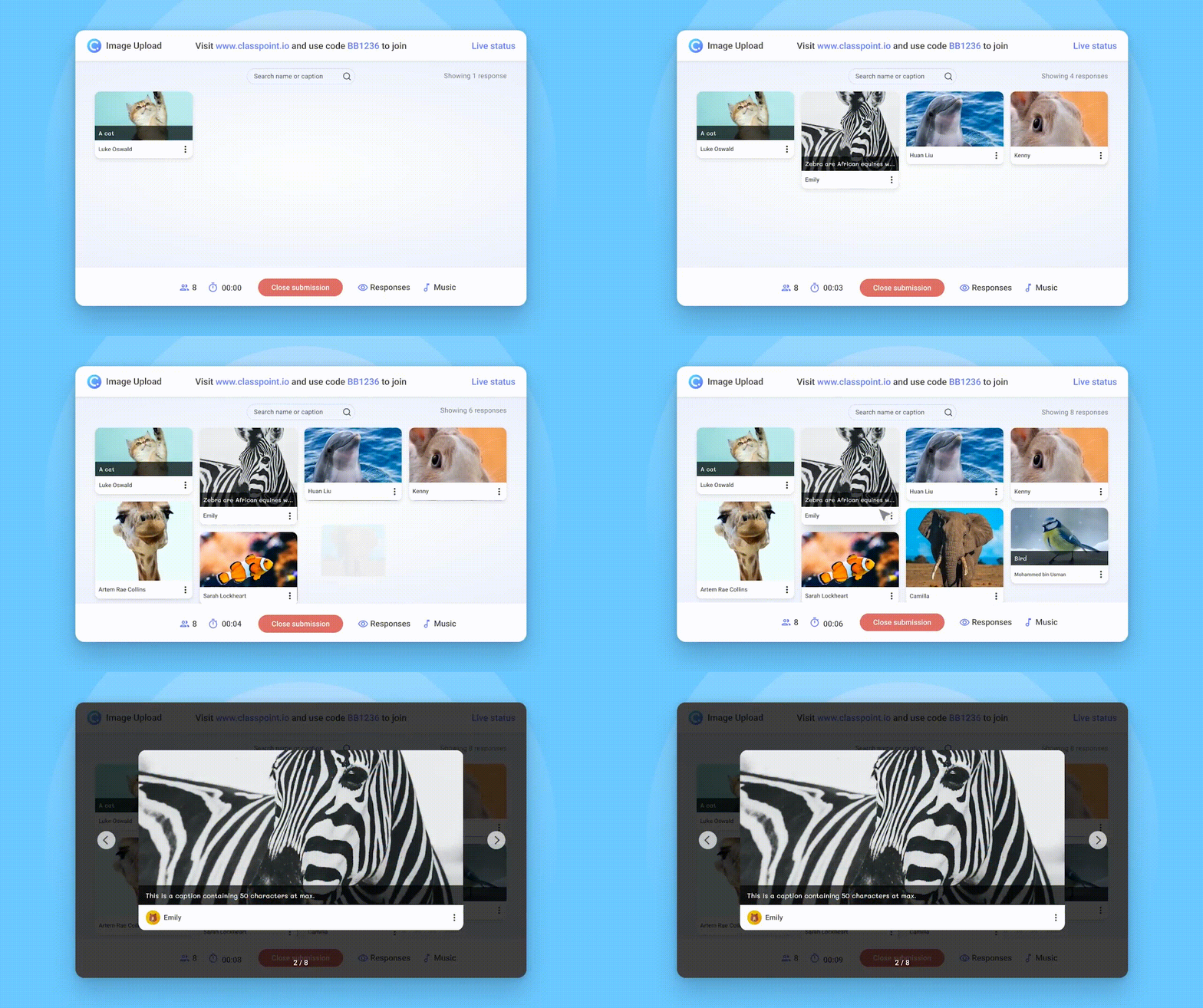
You can also use free tools like Google Slides. Students can freely add images, videos, and audio anywhere on a shared deck, with contributions appearing in real time.
Because these options exist for the entire class at once, no single student is singled out for using them.
In short: When flexibility is built in for everyone, support stops feeling like an exception.
6. Allow Processing Time Without Penalty (often overlooked)

This is probably the most overlooked strategy on this list, and one of the most impactful.
The wait time research mentioned earlier showed that increasing the pause after a question from one second to three seconds led to more students responding across the whole room, and the quality of those responses improved noticeably.
For neurodivergent students managing processing delays, that two-second window can change everything.
Quick wins:
- Pause before collecting answers and let silence sit for a few seconds
- Design activities where the quality of the response matters more than the speed
- Let students revisit a question after discussion closes
- Stop framing quick responses as “better”
No need to announce that this is for anyone’s specific benefit, just do it consistently.
A Word on Gamification and Neurodivergent Students
Anonymity works because it removes the social risk of being wrong in public. Gamification can quietly put that risk straight back in.
Public leaderboards, competitive point rankings, and speed-based scoring all reintroduce the same pressure that anonymous participation was designed to remove.
For neurodivergent students who are already managing more than what’s visible, being ranked against their peers isn’t motivating, it’s one more thing to survive.
Use ClassPoint’s gamification features for personal progress markers instead of public rankings.
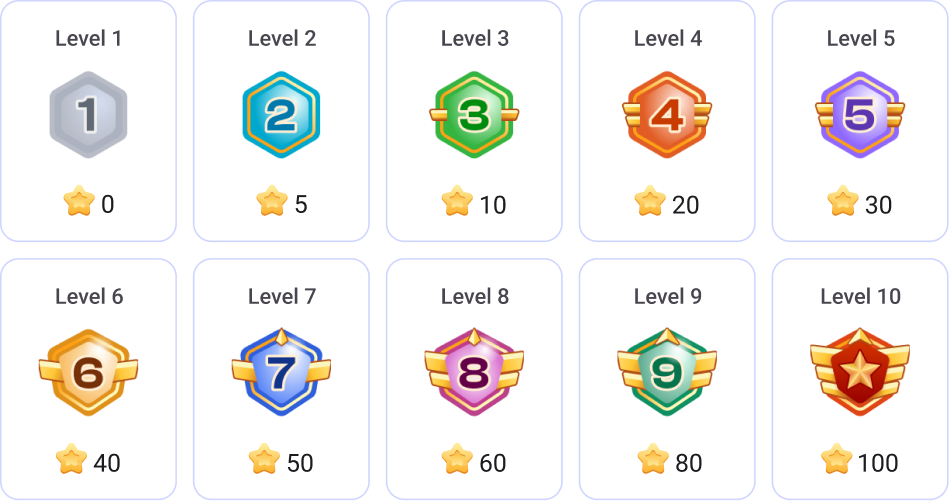
Although competitive in nature, gamification can work differently: as self-development and progress.
Points and badges can work as personal progress markers, not just competition tools.
- Use points as personal progress indicators rather than public rankings
- Use levels to show individual growth over time rather than speed
- Reinforce participation and effort, not just correct answers
The goal is the same as anonymity: make the room feel safe enough that students focus on learning, not on how they look while doing it.
Final Thoughts: Good Teachers Notice. Great Teachers Adjust.
Neurodivergent students don’t need educators to become someone different. They need an honest look at what the current setup rewards and who it quietly leaves out.
Start small. Pick one strategy, maybe it’s visible instructions, maybe it’s anonymous responses, maybe it’s just pausing three seconds instead of one. Try it for two weeks with your next class.
Then watch. Notice who participates for the first time. Notice who stops asking to leave the room. Notice who finally submits work that matches what you knew they were capable of all along.
That’s not a coincidence. That’s what happens when the barrier was never the student, it was the setup.
