A Family Feud PowerPoint template turns any review session into the loudest 30 minutes of the week. Teams huddle, someone shouts an answer too early, the whole class groans when a confident guess gets a strike. And somewhere in the middle of all that, students are actually recalling what you taught them.
This post includes a free, downloadable Family Feud template you can customize for any subject or grade level.
Along with the template, you’ll find question ideas by subject, a step-by-step setup guide, and tips for running the game so you can actually see what your students know while they play.
When to Use Family Feud in Class
Most teachers reach for this Family Feud template when a test is coming up and they want something better than a study guide. That’s the sweet spot, but it’s not the only one.
- Unit review before a test. The most common use. Survey-format questions (“Name three causes of…”) surface what the class remembers and what slipped through.
- Vocabulary reinforcement. “Name a word that means ___” with answers ranked by how common each synonym is. Works for any language-heavy subject.
- First-week ice breaker. Non-academic questions (“Name something you bring to school every day”) let students practice the team format before the stakes go up. Pair it with other interactive ice breakers for a soft start to the year.
- End-of-semester recap. Mix questions from multiple units into one game. Covers more ground in 30 minutes than most written reviews.
- Formative check mid-unit. Run 3 quick rounds to see where the class stands before moving on. No grading, just a read on the room.
Want a different game format? 5 Interactive PowerPoint Game Templates walks through five other classroom-ready PowerPoint games. Pick the format that fits the lesson.
Why Family Feud Works as a Review Activity
Family Feud does three things most review activities don’t:
- Students recall without answer choices. “Name a cause of the Civil War” has no A, B, or C to eliminate from. They have to pull it from memory, and the harder the recall, the more it sticks. Cognitive scientists call this retrieval practice, one of the most replicated findings in learning research.
- Teams discuss before guessing. A student doesn’t just know the answer. They have to say it out loud and convince their teammates it’s worth the risk. That’s deeper than clicking a button alone.
- Wrong guesses show you where the gaps are. When a team confidently guesses something that isn’t on the board, you’ve found a misconception a correct answer would have hidden. Strikes tell you more than points do. Cognitive scientists call this the hypercorrection effect. Students remember corrections to confident wrong answers more strongly than corrections to uncertain ones.
How to Write Good Family Feud Questions (By Subject)
The Family Feud template gives you the game board. The questions are what make it useful. A good Family Feud question has multiple valid answers that students can rank or debate. If there’s only one right answer, that’s trivia, not Family Feud.
Start with “Name a…” or “What is the most common…” and aim for 5 to 8 possible answers per question. Here are examples across subjects:
| Subject | Example question | Why it works |
|---|---|---|
| Science | “Name a renewable energy source” | Multiple valid answers, students rank by importance |
| History | “Name a cause of World War I” | Tests multi-cause thinking, not single-fact recall |
| ELA | “Name a persuasive writing technique” | Connects vocabulary to application |
| Math | “Name a shape with more than 4 sides” | Geometric vocabulary under time pressure |
| General | “Name something students forget on test day” | Low-stakes warm-up, builds team dynamics |
A few things to keep in mind when writing your own:
- Questions with one right answer don’t work. “What year did WWII end?” is trivia. “Name a country involved in WWII” is Family Feud.
- Rank answers by how common or important they are. The top answer earns the most points, just like the show. This pushes students to think about which answers matter most, not just which ones are correct.
- Let students write the questions. Have them create survey questions, poll their classmates, then compile the ranked answers and play the game with their own data. One activity becomes a research, writing, and review exercise.
Save prep time with AI. Short on time? Paste this into ChatGPT or any similar tool:

"Generate 5 Family Feud-style questions with 5 ranked answers each, aligned to [your subject and grade level]. Rank answers from most to least common."

Review for accuracy, adjust the ranking, and you've cut 30 minutes of question writing down to 5.
How to Set Up the Family Feud PowerPoint Template
Download the free Family Feud PowerPoint template below. It comes with question boards, answer reveals, scoring, and interactive quiz buttons already built in.
Family Feud PowerPoint Template
Turn your PowerPoint into a fun Family Feud game experience now!
The Family Feud template runs on ClassPoint, a free PowerPoint add-in that handles the interactive parts: students answer on their devices, you drag to reveal answers, and scores update on a live leaderboard. If you don’t have ClassPoint yet, it takes a few minutes to set up. Once installed, everything in the template works immediately.
You can also run the game without it using verbal responses and manual scoring.
Here’s how to get it ready for your class.
Step 1: Swap in your own questions and answers
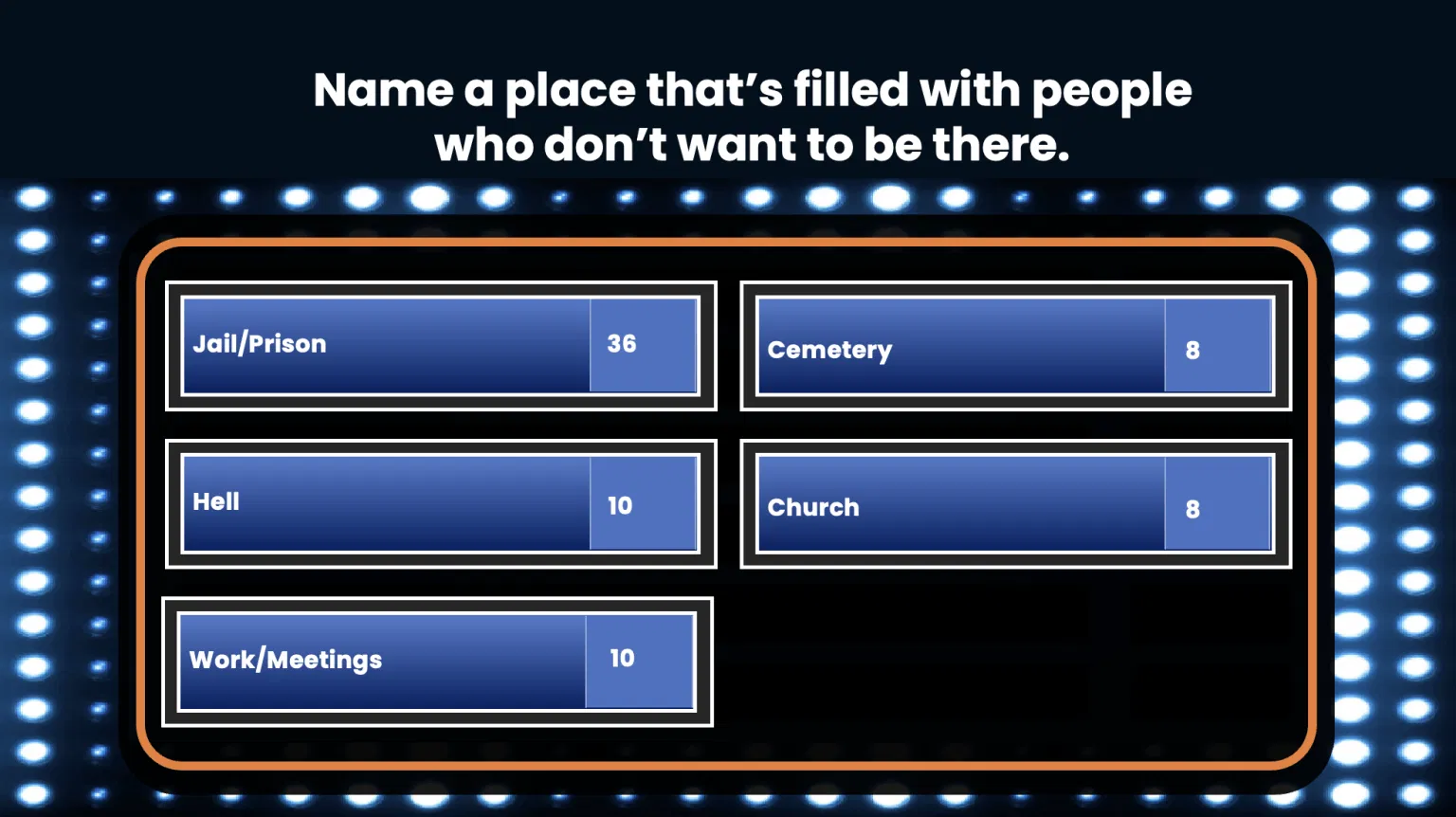
The Family Feud PowerPoint template includes sample questions. Replace them with your own. Each slide is one round with a survey question at the top and a table of ranked answers below.
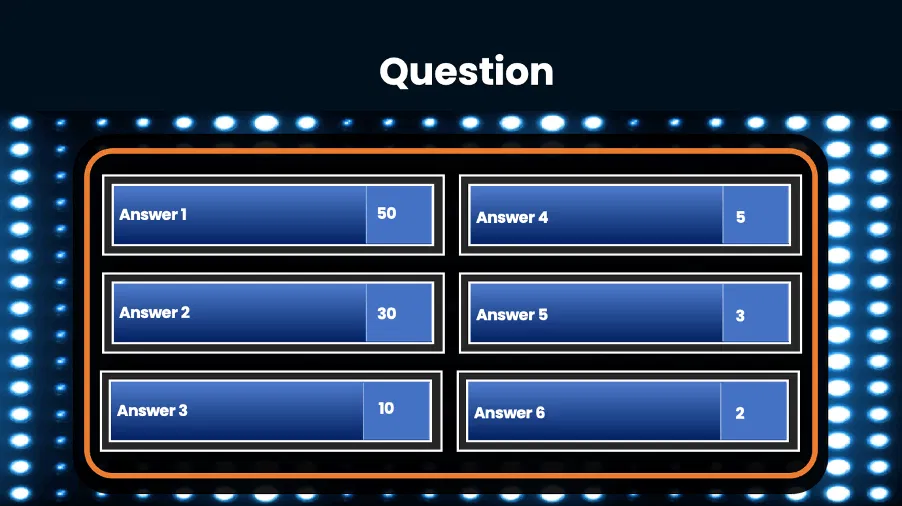
List 5 to 8 possible answers per question, ranked from most to least common. The top answer earns the most points, just like the show.
Step 2: Review the face-off and Fast Money slides
The template includes a face-off slide for the head-to-head opener at the start of each round. One representative from each team races to answer first.
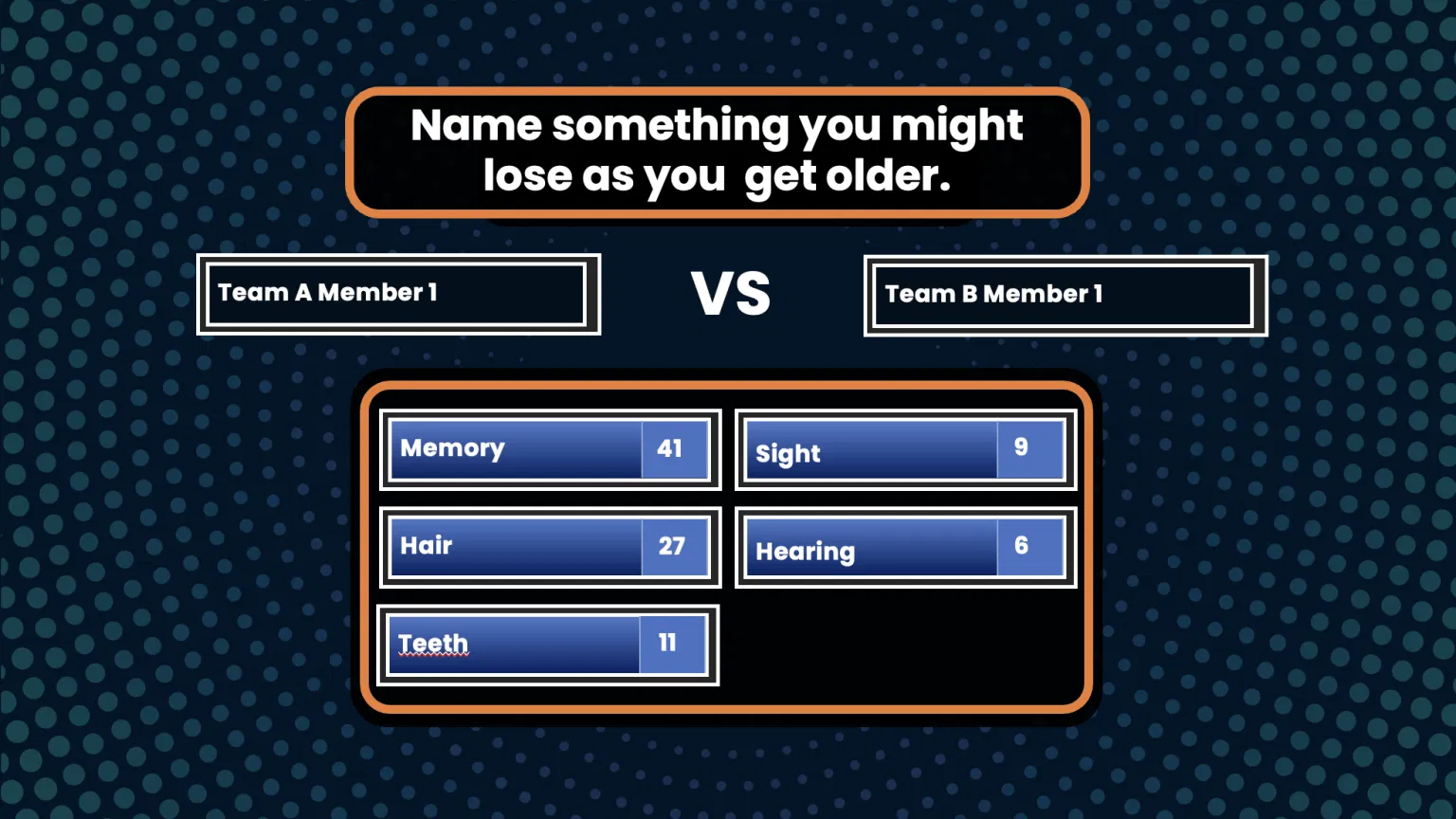
There’s also a Fast Money slide for a bonus round at the end. This is optional but it adds a good energy spike. Use ClassPoint’s built-in timer to limit responses to 20 seconds for the first player and 25 for the second, or time it on your phone.

Step 3: Run it with interactive quiz buttons
This is what makes the Family Feud PowerPoint template interactive. The template has ClassPoint’s Word Cloud and Fill in the Blanks buttons already on each question slide. During the game, students join at classpoint.app on their devices and submit answers at the same time. You see every response, not just the team captain’s.

Prefer to keep it low-tech? Students can call out answers verbally while you track responses on the board. You’ll miss the quieter voices, but the game still runs.
Step 4: Reveal answers with drag-to-reveal
The template uses ClassPoint’s Draggable Objects to cover each answer with a colored box. During the game, drag the box away to reveal the answer underneath. It feels like the real show and gets a reaction every time.

If you’d rather use standard PowerPoint, add a rectangle over each answer and set a “fly in” animation triggered on click.
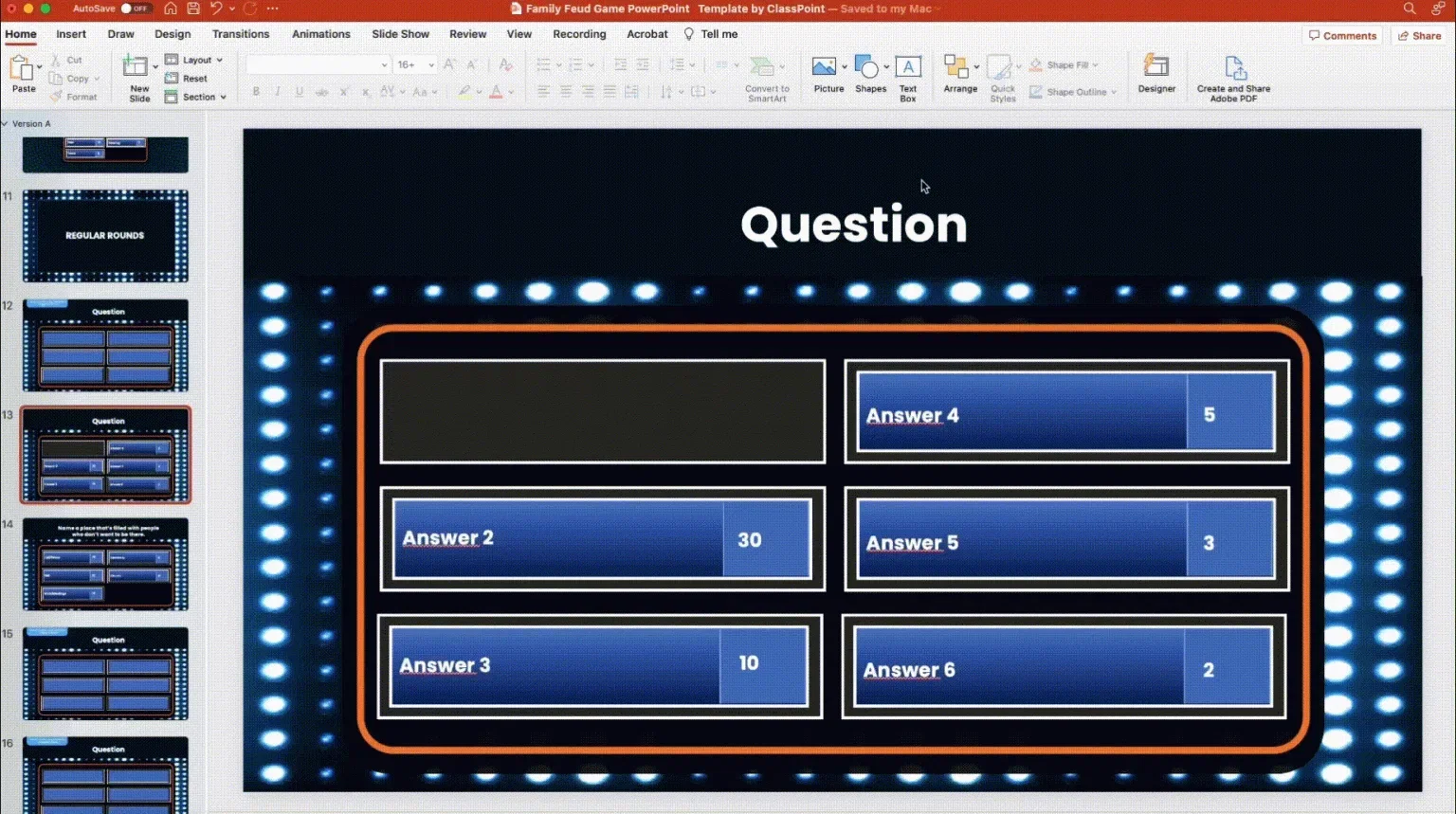
Step 5: Track scores with the built-in leaderboard
The template connects to ClassPoint’s gamification features. Add your team names in My Classes before the game starts. During play, award stars to teams and pull up the leaderboard at any point to show standings.

All you need for manual scoring is a student scorekeeper and the scoring slide already in the template. Update points between rounds and announce standings yourself.
Tips for Running It Smoothly
The template handles the slides. These tips handle the room.
- Keep teams small. 4 to 5 students per team. Two big groups means half the class sits quietly. Smaller teams give more students a reason to talk.
- Rotate who answers. New representative every round. If the same student speaks every time, the rest of the team checks out.
- Give teams 30 seconds to huddle. Set a timer so discussions don’t drag. ClassPoint has one built in, or use your phone.
- Use a buzzer for face-offs. Buzzin.live is free and works on phones. It’s more fair than guessing who raised their hand first.
- Add sound effects. A ding for correct answers and a buzz for strikes takes 10 seconds to set up on your phone and makes the game feel real.
- Pause on the wrong answers. When a team gets a strike, don’t rush to the next guess. Ask: “Why did you think that would be on the board?” That one question turns a wrong answer into a teaching moment.
What to Watch For During the Game
The game runs itself once it starts. Your job is to pay attention to what’s happening underneath the fun.
Say you’re reviewing World War I. A team huddles for 15 seconds and confidently guesses “assassination of Archduke Franz Ferdinand.” Number one answer. Next round, a different team guesses “imperialism.” Not on the board. Strike.
That strike told you something a correct answer never would. The team knew the term but couldn’t connect it to why it mattered. That’s a comprehension gap, not a vocabulary one. A written quiz would have given partial credit and hidden it.
Watch for patterns across rounds. If teams keep guessing events but never causes, that’s the class telling you how they studied. First guesses also reveal confidence: whatever a team says first is what they think they know best.
Notice who’s doing the talking. If one student runs every round, the rest of the team has stopped thinking. Rotate representatives or ask someone else to speak.
Write down the strikes as you go. You’ll use them after.
What to Do After the Game
Don’t let the game end when the last answer flips. You’re sitting on 30 minutes of real-time data about what your class knows and what they only think they know.
Debrief in the last two minutes. Ask which question tripped up the most teams, or what answer they were sure about that turned out wrong. Students are still in the moment, so the answers come fast and honest. That week, pull 5 to 10 questions from the game for a short follow-up quiz. No extra prep, and the students who paid attention will notice.
The most useful thing is your list of strikes. Three teams missing the same concept? That’s tomorrow’s bell-ringer. Half the class confidently guessing something that wasn’t on the board? That’s a misconception worth a mini-lesson, not a passing correction.
The game already did your formative assessment. The strikes tell you what to do next.
If you used ClassPoint’s quiz buttons, every student response is saved in your class reports with slide-by-slide breakdowns. Running a saved class? The data carries over across sessions, so you can compare how understanding shifts from one review game to the next.
The Template Is the Easy Part
A Family Feud PowerPoint template gives you a working game board in 5 minutes. That’s the easy part.
What makes it work in class is something the template can’t do for you: the questions you write before class, and the strikes you notice during the game. Run it once and you’ll see. Students remember the rounds they got wrong far more than the rounds they won. That’s not a bug. That’s the whole point.
If this format lands with your students, Jeopardy and Trivia work the same way. Same idea, different game shape, pick whichever fits the next unit.
Family Feud PowerPoint Template
Turn your PowerPoint into a fun Family Feud game experience now!
Further Reading:
